
Emotions the Estate Planning Process Can Bring Up and How to Address Them

People often have a ready list of reasons—or depending on how you look at it, excuses—for putting off completing their estate plan: “I just haven’t gotten around to it yet”; “I don’t own anything of value”; “It’s too complicated”; “It’s too expensive”; “My family can handle things when I’m gone”; or “I’ll wait until I’m older and really need one.” These attitudes are reflected in the numbers; most Americans have no estate plan, and many do not intend to create one.1

However, lurking beneath the surface is perhaps a more powerful and all-encompassing motivation for their inaction: a desire to avoid the complex emotions that often accompany estate planning.

Estate planning requires confronting emotionally charged topics. While thinking about your potential incapacity (inability to manage your own affairs) or death may be unsettling, avoiding uncomfortable topics and the feelings they trigger can often make the situation worse for you and your loved ones.

Instead of avoiding these topics, try to recognize and reframe the estate planning process as the opportunity to take control and create something positive and productive. You will feel more empowered by taking action now, and your family will thank you later.

Why We Avoid Estate Planning: The Psychology Behind “Not Yet”

Estate planning is not merely a legal process; it is also an emotional one.

Some people may admit that they would “rather not think about” estate planning or they are “not ready yet.” But among those who keep putting off their plan, chances are that estate planning is never far from their mind, at least indirectly.

A 2025 survey found that nearly one in five people think about their own death at least once daily and about two-thirds have given serious thought to their end-of-life arrangements.2 Many have even decided on the details of how they want to be buried (29 percent), the location of their final resting place (19 percent), and the type of service they want (17 percent).3 Fourteen percent said they have even curated their funeral playlist.4

At the same time, death and estate planning ranked as the second-most difficult subject to talk about with loved ones, along with topics such as mental health, past mistakes, and regrets.5 Twenty-five percent of respondents called death and estate planning “uncomfortable.”6

The survey reveals a key barrier to the estate planning process: thinking about death privately and discussing it with others are two very different things.

While avoiding topics that spark complex emotions may feel easier in the short term, it can reinforce negative feelings over time and make it harder to act on important matters, including estate planning, even when you know it is necessary.

However, the same emotions that make estate planning difficult can become the very means that help you complete it—if you learn how to appropriately reframe your feelings.

Turning a Negative into a Positive: Estate Planning and Emotional Reframes

Emotion and cognition are closely linked. Strong emotions make it harder to think and act by disrupting the very processes required to analyze problems and identify possible solutions.

Psychological research indicates that naming and reframing emotions can enhance emotional regulation, sharpen thinking, and improve decision quality.

This approach, known as cognitive reappraisal, involves changing how you interpret a situation to alter its emotional impact.7 By focusing on aspects of a situation that evoke positive emotions rather than negative ones, you make it easier to solve problems and achieve your goals.

In the context of estate planning, you should not be expected to ignore difficult emotions. In fact, these strong emotions often mean that what you are doing truly matters. Denying your emotions can hinder progress, while reframing them as useful signals can help you move forward.

In practice, applying cognitive reappraisal to estate planning might look something like this:

  • Fear → Control and Readiness
    Fear often arises when the unknown feels bigger than what we can manage. Reframing it as a cue to gain control by organizing documents, clarifying intentions, and identifying decision-makers can help transform fear into action. Fear, in this light, becomes the starting point for readiness.
  • Sadness → Legacy and Meaning
    Sadness often appears because of real or perceived loss, but it can also reveal what matters most to you. By channeling that emotion into expressing your legacy—writing letters, creating trusts for loved ones, or supporting causes that reflect your values—you can turn grief into purpose.
  • Anger → Fairness and Clarity
    Anger often grows from family conflicts, blended family tensions, or perceived injustices. Reframing anger as a drive toward fairness and clarity enables that energy to fuel precise, balanced planning, which reduces later confusion and conflict.
  • Anxiety → Preparedness and Confidence
    Anxiety often stems from uncertainty. By naming what worries you, such as finances, taxes, and medical decisions, and directly addressing those issues in your plan, you replace vague dread with concrete action and certainty. Each completed step reinforces calm and confidence.

Ultimately, the goal of cognitive reappraisal is to turn negative emotions such as anger, fear, and sadness into positive ones, including happiness, peace, and joy: happiness that you finally got your plan together, the peace of mind that comes from transforming uncertainty into vision, and the joy of knowing that your loved ones will be taken care of and protected when you are gone.

The process itself can be a powerful act of self-understanding. If, at the end of it, you feel lighter, calmer, or more at peace, it is because of the relief that comes from clarity and resolution, not from avoidance, denial, or wishful thinking. You have faced something difficult and deeply human, taking control not just of your money and property, but also of your narrative and legacy.

Be Courageous and Meet with Us

There is an idea in philosophy that all stories are ultimately about fear of death and reflect our struggle to face mortality. A similar psychological truth might explain why so many people hesitate to create an estate plan.

Even when they do, the process often touches every emotional nerve. It can surface old family conflict, unspoken expectations, and differing ideas of what is “fair.” It asks us to imagine a world without ourselves in it, to assign value to what we have built, and to make choices that may please some loved ones but not others. That is a tall emotional order, even for the most pragmatic person.

But estate planning can also bring moments of connection, reflection, and gratitude. It can stir up difficult emotions—and resolve them as well. The difference ultimately lies in your perception.

Estate planning is more than paperwork. It is an act of courage. A simple reframe may be all you need to take that next step and meet with an attorney to help you address your feelings and channel emotions into action. If you are ready to name and reframe those emotions and take charge of your legacy, call us.


  1. Victoria Lurie, 2025 Wills and Estate Planning Study, Caring (Sept. 17, 2025), https://www.caring.com/resources/wills-survey. ↩︎
  2. Two-Thirds Of Americans Have ‘Planned’ Their Funerals, But Majority Avoid Estate Planning Conversations, StudyFinds (Sept. 30, 2025), https://studyfinds.org/americans-planned-funerals-avoid-estate-conversations. ↩︎
  3. Id. ↩︎
  4. Id. ↩︎
  5. Id. ↩︎
  6. Id. ↩︎
  7. Cognitive Reappraisal, PsychologyToday, https://www.psychologytoday.com/us/basics/cognitive-reappraisal (last visited Nov. 20, 2025). ↩︎

Retirement Planning for Business Owners

Many employees save for retirement by participating in their employer’s 401(k) plan and maybe even opening an individual retirement account (IRA) or Roth IRA for additional savings.

As a business owner, planning for retirement requires more effort, foresight, and strategy. In addition to navigating the wide range of retirement account options available to business owners, you must also ensure that your chosen strategy aligns with your overall estate plan.

Like any other working individual, business owners want to ensure that they will have sufficient retirement savings. They often pour all their time, resources, and extra funds into their business, assuming that it will serve as their retirement plan. However, relying solely on the future success of your business, instead of proactively saving for retirement, could be a costly mistake.

Retirement Account Options for Business Owners

Instead of relying on a single strategy, it is wise for business owners to diversify their retirement planning. Like any other important financial decision, having multiple backup options in place can provide greater security, flexibility, and tax efficiency over time. Business owners have access to a wide range of retirement accounts—far more than traditional employees—and each option comes with its own contribution limits, tax benefits, and administrative requirements.

Although the number of choices can feel overwhelming, working with a qualified tax or financial professional can help simplify the process. An advisor can evaluate your business structure, income patterns, and long-term goals to recommend the most appropriate retirement vehicles.

Traditional Retirement Plans for Business Owners

Opening a retirement plan such as a solo 401(k); a Simplified Employee Pension IRA (SEP-IRA); a Savings Incentive Match Plan for Employees (SIMPLE) IRA; or a pension plan can offer numerous benefits that allow business owners to grow their wealth outside of their business. A solo 401(k) is a retirement plan designed for self-employed business owners who have no employees other than a spouse. One of its biggest advantages is that the owner can make contributions in two roles—as both the “employee” and the “employer”—which can allow for significantly higher total contributions than many other retirement plans. Other plans, such as SEP-IRAs, SIMPLE IRAs, and pension plans, can cover both the owner and eligible employees, offering retirement savings and tax benefits for everyone involved. When a business owner contributes to one of these plans, they can lower their taxable income in the year the contributions are made. Additionally, because investments in these accounts grow tax-deferred, business owners do not pay taxes on earnings until retirement, allowing their savings to compound and potentially grow more rapidly over time.

The best plan for your business will depend on several key factors, including

  • how much income your business earns,
  • the stability of your business,
  • how many employees you have, and
  • how much you are willing to contribute on behalf of your employees.

Most tax-deferred retirement plans must comply with federal nondiscrimination laws, which are designed to ensure that benefits do not unfairly favor business owners or highly compensated employees—for example, by offering a plan that covers only the owners while excluding full-time staff. Only certain plans, such as a solo 401(k), are designed specifically for business owners with no employees and can legally exclude others without violating these rules. However, offering retirement plans to employees does not have to be seen as a drawback; many employees highly value the opportunity to save for their retirement, and your contributions may be rewarded with improved employee performance and long-term loyalty.

Self-Directed Accounts for the Bold Business Owner

Depending on how many employees you have and your comfort level with investing, you may also consider a self-directed retirement plan, which allows you to invest some or all of your retirement funds in alternative investments, such as precious metals, private lending arrangements, real estate, or interests in closely held businesses. These self-directed accounts may not be suitable for everyone. They require a high level of responsibility and risk tolerance, the tax rules governing them are complex, and penalties for mistakes can be severe. However, for the right person, they can open up a wider range of investment opportunities. Still, these should always be managed with the guidance of qualified professionals, such as a tax advisor, a financial planner, or an attorney experienced with self-directed retirement accounts.

Beyond Your Business: Traditional Retirement Accounts

Besides your business retirement plan, you may also be able to contribute to a traditional IRA or a Roth IRA. Doing so can serve as a way to add more money to your retirement, especially if you have maximized your contributions to the plans tied to your business. Additionally, contributing to an IRA outside of your business can help diversify some of your retirement savings and provide extra stability. Specific contribution limits apply across all IRAs, so it is important to be aware of how much you can contribute each year to stay compliant with Internal Revenue Service rules. The differences between traditional IRAs and Roth IRAs are as follows:

  • Traditional IRA contributions may be tax-deductible, depending on your income and whether another retirement plan covers you (or your spouse). Earnings grow tax-deferred until withdrawal in retirement.
  • Roth IRA contributions are funded with after-tax dollars, so they are not tax-deductible. Qualified withdrawals are tax-free in retirement.

Similar to the employer-sponsored retirement plans you can establish and participate in as a business owner, traditional IRAs and Roth IRAs can also be self-directed, allowing you to further expand your investment options beyond traditional stocks and mutual funds into assets such as real estate, private lending, and other alternative investments.

Healthcare-Related Savings Tools

As a business owner, you likely have a great deal of control over your health insurance decisions. If you are relatively young and healthy or are otherwise an infrequent user of healthcare services, consider pairing a high-deductible health plan (HDHP) with a health savings account (HSA) to boost your savings. HDHPs enable you to contribute pretax money to an HSA, which can be invested similarly to IRAs. Once you set up the account, you can withdraw your contributions and earnings tax-free at any time to pay for qualified medical expenses. However, withdrawals for nonqualified medical expenses are subject to income tax and a 20 percent penalty. After you turn 65, you can use the money for any purpose without facing the 20 percent penalty, though withdrawals for nonmedical expenses will be subject to regular income tax.

Funding Retirement by Selling or Transferring the Business

Many business owners dream of a financially lucrative exit from their company funded by selling, going public, or otherwise transferring their ownership interest for a substantial profit that reflects years of hard work and growth. A successful exit does not happen by accident; a business owner must first build and maintain a profitable enterprise that is attractive to potential buyers. From there, careful legal and tax planning is essential to minimize burdensome taxes and avoid the common legal risks that can arise during a sale. The net proceeds from selling a business often become a significant component of the owner’s retirement savings. When supplemented by one or more of the retirement accounts discussed above, such a strategy can create a strong foundation for long-term financial security.

Additional considerations exist for owners of family businesses who want to pass their company down to children or grandchildren. As with any other exit strategy, this approach still requires creating and sustaining a profitable enterprise. However, determining how the business owner will tap into the company’s value to fund their own retirement is less straightforward. Thoughtful planning for the transition to the next generation is essential. A business may be transferred to heirs outright or through a trust, which effectively moves ownership to them. Without additional planning, that transfer can limit or eliminate the owner’s ability to rely on the business’s value to fund retirement. Alternatively, the next generation or even key employees could buy out the owner’s interest or pay consulting fees during the owner’s retirement years, allowing the owner to draw on the business’s value while ensuring a smooth transition of control to the next generation.

The Importance of Estate Planning

Regardless of which retirement accounts or strategies you select, integrating them into your estate planning is crucial. Fortunately, several planning tools exist to help you do so effectively.

You can use basic estate planning tools to help ensure that your retirement assets transfer smoothly to your chosen beneficiaries. One strategy is to name your intended beneficiaries directly on your retirement accounts, allowing those assets to pass to them immediately without going through probate. Another option is to coordinate your beneficiary designations with your revocable living trust so that the funds flow into the trust and are managed and distributed according to its terms, helping to ensure greater control, protection, and consistency with your overall estate plan.

A more-advanced planning tool is an IRA trust, which can either be established as a standalone trust or included as a subtrust within your revocable living trust. This specialized trust is designed to maximize the financial benefits of inherited retirement assets, minimize the income tax burden, and provide robust asset protection for your beneficiaries.

Leverage the Team Approach

We can work with you and your team of professionals, including business advisors or consultants, tax advisor, and financial advisor, to develop a comprehensive retirement, business transition, and estate planning strategy. Working collaboratively, we can focus on setting aside assets for your retirement and preserving tax advantages while freeing you to do what you do best: build and grow your business.

Contact us today to develop a customized strategy tailored to your specific needs.

Committed, Protected, Prepared: Estate Planning Tips for Unmarried Partners

More couples than ever are building deep, lasting relationships without ever walking down the aisle. Whether by choice, circumstance, or principle, many Americans are opting out of marriage—but not out of commitment. Data indicate that cultural norms regarding marriage in the United States have undergone significant shifts over the past several decades. Consider the following:

  • The number of unmarried partners in the United States more than tripled between 1996 and 2018, from 6 million to 19 million.1
  • Among adults aged 30 and younger, 12 percent were living with an unmarried partner in 2019, compared with 5 percent in 1995.2
  • The percentage of US households headed by married couples as of 2024 (47 percent) was at its second-lowest point since the US Census Bureau began tracking marital status in 1940.3

However, the law has not kept pace with modern relationships. If you and your partner choose not to marry, you must have an estate plan tailored to your individual situation. Without an estate plan, your partner generally has no legal authority to make decisions for you if you become injured or incapacitated (unable to manage your own affairs) or to inherit from you when you pass away. Dying without an estate plan—known as dying intestate—means state law determines who receives your assets. These laws rarely account for long-term, unmarried partners, making it essential to create a will or trust to ensure that your wishes are honored and your partner is protected.

Revocable Living Trusts

A revocable living trust allows you to set clear instructions for how your money and property are to be managed and distributed—during your lifetime, while you are alive and well, if you become incapacitated and unable to manage your own affairs, and after your death. While you are alive and well, you are typically the trustee and can use the money and property in your trust just as you normally would use your money and property. If you become incapacitated, your chosen successor (backup) trustee can step in to manage your affairs seamlessly, without court involvement. After your death, the trust directs how your assets are distributed to or managed for your beneficiaries, often avoiding probate and keeping matters private.

Though trusts often cost more to create than the common alternative—a last will and testament—the benefits they provide cannot be easily or reliably replicated with other planning tools. Overall, a trust is often the stronger choice and can serve as the cornerstone of almost any comprehensive estate plan, especially for couples who have not formalized their relationships with a legal marriage.

Wills

A last will and testament (commonly called a will) is an estate planning tool that allows you to direct what will happen to your accounts and property at your death. It also allows you to nominate someone—often called an executor, a personal representative, or an administrator—to wind down your affairs when you die and ensure your wishes are carried out. If you have minor children, this is also the document in which you can nominate a guardian to care for them in the event of your passing. While a will can accomplish many of the same goals as a revocable living trust, it does not provide a means to manage your affairs during your lifetime or in the event of potential incapacitation. It also has to go through the court-supervised probate process, which can make things more time-consuming, public, and expensive for your loved ones.

A special type of will, known as a pour-over will, is a straightforward yet crucial component of any trust-based estate plan. Think of it as a safety net for anything you may have forgotten to transfer into your trust during your lifetime. If you still own something—such as a bank account or piece of property—in your sole name and without a beneficiary when you pass away, the pour-over will ensures that it “pours over” into your trust after your death. While your loved ones may still need to go through probate to transfer those things to the trust, this type of will ensures that everything ultimately ends up in the right place and is handled according to your trust’s instructions.

Beneficiary Designations

Most retirement accounts and insurance policies (and many other types of accounts, too) allow you to designate a beneficiary, which is the person who will automatically receive what is in the account when you die. It is essential to periodically review the beneficiaries listed on your accounts to ensure they are up-to-date. Imagine naming your ex-spouse as the beneficiary of your 401(k) before your divorce and then forgetting to update it once the divorce was finalized. Unfortunately, that oversight could mean your ex is still legally entitled to receive the account when you pass away, unintentionally cutting out your current partner or other loved ones you intended to provide for. 

Depending on your trust’s design, your personal circumstances, and your specific goals, you may choose to name one or more trusts as the beneficiary instead of, or in addition to, individual people. This approach can provide more control over how and when these accounts are distributed, especially if you want to protect beneficiaries from taxes, creditors, or their own spending habits.

Powers of Attorney, Advance Directives, and Similar Legal Documents

Planning for what happens after death is only one part of a comprehensive estate plan. Incapacity—when you are alive but unable to make decisions for yourself—is another situation where legal planning can help you stay in control, ensure your wishes are followed, and reduce the likelihood of family conflict. Without documents that address incapacity, your loved ones may have to go to court to have someone appointed to manage your medical and financial affairs (often referred to as a guardianship or conservatorship). When that happens, the judge looks to state default rules about who gets priority—and unmarried partners are often left out entirely. To avoid this situation, you should consider creating or updating the following estate planning documents:

  • Medical power of attorney: allows you to name someone (such as your significant other) to make healthcare decisions for you if you cannot communicate them yourself
  • Financial power of attorney: allows you to name someone you trust (again, possibly your significant other) to handle your financial and legal matters if you are unable to do so
  • Advance directive: where you can express your wishes regarding end-of-life care, including what you would like to happen if you are in a persistent vegetative state or end-stage condition
  • Health Insurance Portability and Accountability Act (HIPAA) authorization: gives the people you name permission to access your protected health information so they can stay informed about your medical condition

Securing Your Shared Future

Whether you have been together for decades and are nearing retirement or are just beginning to build your life as a couple, it is important to ask some key questions about how you want to protect each other. Who will make decisions for you if you cannot? Who will inherit what the two of you have worked so hard for? And how can you make sure the law does not overlook the person who means the most to you? Taking the time now to create or update your estate plan ensures that your wishes are honored and that your partner is protected—no matter what the law says about your relationship status.

Our experienced estate planning attorneys can help you identify a strategy to get the peace of mind you need. Call us to schedule a private consultation.


  1. Mike Schneider, Unmarried partners in US have tripled in 2 decades, AP News (Sept. 24, 2019), https://apnews.com/article/848605aad88a418c9b606c0f745ae33f. ↩︎
  2. Juliana Menasce Horowitz et al., The landscape of marriage and cohabitation in the U.S., Pew Rsch. Ctr. (Nov. 6, 2019), https://www.pewresearch.org/social-trends/2019/11/06/the-landscape-of-marriage-and-cohabitation-in-the-u-s/. ↩︎
  3. How has marriage in the US changed over time?, USAFacts (Feb. 11, 2025), https://usafacts.org/articles/state-relationships-marriages-and-living-alone-us/. ↩︎

Avoid Living Probate: How to Keep Guardians and Conservators Out of Your Estate

While many proactive individuals understand the importance of having a comprehensive estate plan, they often assume that their plan addresses only what happens after they pass away. However, a comprehensive estate plan is also meant to positively impact your life by planning for and providing necessary protections while you are still around to reap the benefits.

Planning for Incapacity

Incapacity—the inability to handle your own personal or financial affairs because of a mental condition—can happen at any stage of life. Nearly 29 percent of adults across all age groups live with some form of disability, and about 14 percent live specifically with a cognitive impairment.1 The likelihood of experiencing incapacity only increases with age: More than 30 percent of Americans over 65 have a disability, and that number goes up to more than half for those above 75 years of age.2 Many people who reach advanced age eventually experience physical or cognitive decline that affects their ability to manage their personal, financial, or legal affairs. In many cases, this loss of capacity is caused by dementia, a stroke, or other age-related cognitive impairments that make it difficult or impossible for an individual to make informed decisions or advocate for themselves. Proactive estate planning allows you to decide in advance how your affairs will be managed if you become incapacitated. Without a comprehensive plan, the court may have to intervene and appoint someone to act on your behalf. At that point, decisions made (or not made) earlier in life can have major repercussions for you and your loved ones, affecting your lifestyle, medical care, and financial security.

Here is an example:

When Alex was in his 40s, he put together a cursory estate plan—a simple will detailing who would get his accounts and property upon his death. However, Alex did not update his plan as he aged. In his late 70s, he developed Alzheimer’s disease, and his family suddenly found themselves unclear about who could step in and act on his behalf or even what his healthcare and financial wishes were. Because Alex had not legally appointed an individual to handle his affairs for him if he became incapacitated, the court had to get involved and appoint a guardian.

What Is a Guardian or Conservator?

A guardian or conservator is an individual appointed by the court to make decisions on behalf of an incapacitated person who did not appoint someone to do so through comprehensive estate planning prior to losing capacity. A guardian or conservator of the person makes decisions about an individual’s personal and medical care, while a guardian or conservator of the estate manages their financial and legal affairs. The specific terminology may differ by state, but the underlying responsibilities are generally the same. The name of the court proceeding for appointing a guardian or conservator may also vary. Some states call it a guardianship, others a conservatorship, and still others use the term plenary guardianship. People may also informally refer to it as living probate.

Four Reasons to Avoid Guardianship or Conservatorship

In a living probate proceeding, the court’s goal is to determine and implement solutions that will serve the incapacitated individual’s best interests. However, relying on a court-appointed guardianship or conservatorship is not an ideal substitute for comprehensive estate planning for several reasons:

  1. High costs. Simply put, living probate is expensive. Legal fees and court costs can quickly chip away at the value of your money and property, leaving less for your care and for your loved ones after you pass.
  • Family conflict. Another significant drawback of living probate is the potential for family conflict. When a court must decide who will manage an incapacitated person’s affairs, relatives may disagree over who is best suited for the role or how decisions should be made. These disputes can quickly escalate into emotional and expensive legal battles, straining relationships and diverting focus from the incapacitated person’s care and well-being.
  • Lack of privacy. Living probate is a court-supervised proceeding and becomes part of the public record, meaning that aspects of your private, medical, and financial affairs are often open to public view. Returning to our example, if Alex had known he could have addressed incapacity in his estate plan, he might have appreciated that doing so would spare his loved ones the financial and emotional burden of a living probate proceeding. Perhaps even more important, he may have seen the value of keeping his personal and financial affairs private rather than having them aired in a public forum.
  • Lack of clarity. Living probate is also full of guesswork. If Alex had appointed people he trusted as agents under medical and financial powers of attorney and expressed his wishes for end-of-life medical care in his estate plan, his affairs would be handled exactly as he wished during his incapacity. However, without having legally documented his preferences, he has no control over clarifying his wishes, and the court must intervene. While the court does its best to determine what is in Alex’s best interests, it may appoint someone whom Alex would not have wanted to act for him. Additionally, once Alex’s care is under court supervision, the court may impose restrictions or require prior approval before certain decisions or transactions can be made.

How to Structure Your Estate Plan

Fortunately, living probate can be avoided. You can take a few specific steps in your estate plan to ensure that your affairs never end up in a court-appointed guardian’s hands:

  • Powers of attorney. A complete estate plan includes durable powers of attorney, which allow you to appoint trusted individuals, called agents,to act on your behalf if you become unable to manage your financial or medical affairs. These documents ensure that the people you select, not the court, are the ones making decisions for you. In addition to granting authority over healthcare or finances, powers of attorney can also include nominations for a guardian or conservator in case court involvement ever becomes necessary. While a judge still makes the final appointment, naming your preferred person in advance gives you a voice in the process and significantly increases the likelihood that your wishes will be honored. There are several types of powers of attorney, each serving a specific purpose. For example, a healthcare power of attorney allows a trusted individual to make medical and personal care decisions if you cannot, while a general durable (financial) power of attorney authorizes someone you trust to manage your financial affairs, such as paying bills, handling investments, or making business-related decisions. Together, these documents ensure continuity, reduce family conflict, and keep control in the hands of those you choose instead of leaving those decisions to a judge who has never met you.
  • Long-term care planning. You may never need long-term care in the form of ongoing assistance with daily activities or medical support that can arise from illness, disability, or aging. However, building a long-term care strategy into your estate plan provides peace of mind and ensures that you will receive care according to your wishes if it becomes necessary. For example, you can state in an advance directive your preferences regarding your end-of-life medical treatments. This type of planning may also help protect your money and property from being used up on medical expenses instead of going to your beneficiaries.

Avoiding guardianship and conservatorship—and the stress and expense of living probate—is a relatively pain-free process if handled well ahead of time. Call us today to review the parts of your estate plan that may need updating to ensure the best possible outcome for you and your loved ones. We can quickly ensure that your plan is comprehensive, current, and built to protect your wishes.


  1. Disability Impacts All of Us Infographic, CDC (Apr. 14, 2025), https://www.cdc.gov/disability-and-health/articles-documents/disability-impacts-all-of-us-infographic.html. ↩︎
  2. Aging and the ADA, ADA Nat’l Network, https://adata.org/factsheet/aging-and-ada (last visited Nov. 7, 2025). ↩︎

Stress Test Your Estate Plan

Creating an estate plan is a huge accomplishment. However, your work is not done when the documents have been signed. You must still ensure that the chosen strategy gives you peace of mind and protects the legacy you have worked so hard to build.

An estate plan is not static; it is a living tool that should evolve with the changes in your life. Over time, your family circumstances, financial picture, and estate planning goals will likely shift. Whether through new births or children getting older; career or business developments; or changes to your investments, health, or where you live, countless factors can affect your evolving estate planning goals. External factors, such as new tax legislation or emerging financial instruments, could also throw your plan off track or open the door to new planning opportunities.

You do not need to spend countless hours worrying about your estate plan. Just ask yourself these nine simple questions to stress test your plan and determine whether it is time for an update.

1. When did you last update your will or living trust? In most cases, reviewing an estate plan every three to five years is sufficient, but if a major life change happens sooner, it is a good idea to take another look immediately. The more time that has passed, the more likely there have also been changes in the law that could affect how your plan works.

2. Whom have you named as executor and trustee? Are the people you chose to wind down your affairs still the right fit? Sometimes people choose a loved one out of obligation, even if that person may not be the best at managing money or handling difficult situations. Ask yourself: Is the person I chose still willing and able to handle this responsibility? Am I confident that they understand my values and will act in a way that reflects my wishes?

3. Do you have adequate life insurance? Life insurance is an effective way to provide for yourself (depending on the type of policy) and your loved ones after your death. But instead of just purchasing any policy, it is important to ensure that you have the right kind of insurance (for example, term, whole, or universal) and the right amount of coverage for your needs. For each of your policies, regularly review and update your beneficiary designations. Each policy should name both a primary beneficiary who is first in line to receive the proceeds when you pass and a contingent (backup) beneficiary, in case the primary beneficiary cannot inherit the proceeds. If you have a trust-based estate plan, your attorney may have recommended naming your trust as a primary or contingent beneficiary. This strategy allows the proceeds to flow directly into your trust, which can be managed and distributed according to your wishes. Regularly reviewing your beneficiary designations ensures that your life insurance policies will pass smoothly and according to your wishes, protecting your loved ones from delays, confusion, or unintended outcomes.

4. Which of your accounts or pieces of real property are jointly owned with someone other than your spouse? Jointly owned property can sometimes cause unexpected tax issues. Look at your real property records and seek advice from a professional to ensure your accounts and property are titled in the most tax-efficient way while still carrying out your planning objectives.

5. How is your recordkeeping? Good recordkeeping will make your loved ones’ job much easier if they need to step in for you while you are alive but unable to manage your own health or finances, or when the time comes to wind down your affairs after your death. Do you have an up-to-date list of all your bank and investment accounts, employee benefits, retirement plans, online passwords, and key legal documents in one safe place? If not, now is a good time to create one. Having this information organized, accessible, and secure helps ensure that your loved ones can step in smoothly without unnecessary stress or delay.

6. Has your health or the health of a loved one changed? If you or someone close to you has been diagnosed with a serious illness, it is important to review your estate plan to ensure that it reflects your current circumstances. You may want to update your healthcare and financial powers of attorney to ensure that your decisions will be managed by someone you trust who understands your wishes. You may also consider revisiting your living will, trust provisions, or long-term care planning to ensure your plan provides the right protection and support for yourself and your family.

7. Have you experienced a major financial change? Your estate plan should always reflect your current financial picture. If you have received an inheritance, come into a large sum of money, sold or purchased significant assets, or made new investments, reviewing and updating your estate plan is important. Such changes can affect tax exposure, distribution goals, and even beneficiary designations. Keeping your plan aligned with your financial reality ensures that your wealth is protected and passes according to your intentions.

8. Do you have a plan for your digital life? In today’s world, so much of our personal and financial life exists online, yet many overlook these assets in their estate plans. Digital assets include cryptocurrency, online accounts, social media profiles, email, cloud storage, and even monetized platforms or websites. A thoughtful plan should identify these assets, authorize who can access them, and provide clear instructions on managing or transferring them. Without proper planning, valuable or sentimental digital property can be lost, locked, or mishandled. Including your digital life in your estate plan ensures that your online presence and assets are protected and passed on according to your wishes.

9. When did you last give your plan a thorough once-over? Even if nothing major has happened, we recommend having your plan reviewed by an experienced estate planning attorney every three to five years. This precaution can help you catch small issues before they become big problems. If any of these questions made you pause, it might be time to review your plan. We are here to help you get the peace of mind that comes from knowing that you and your loved ones are protected. Please call us to schedule an appointment to review your estate plan.

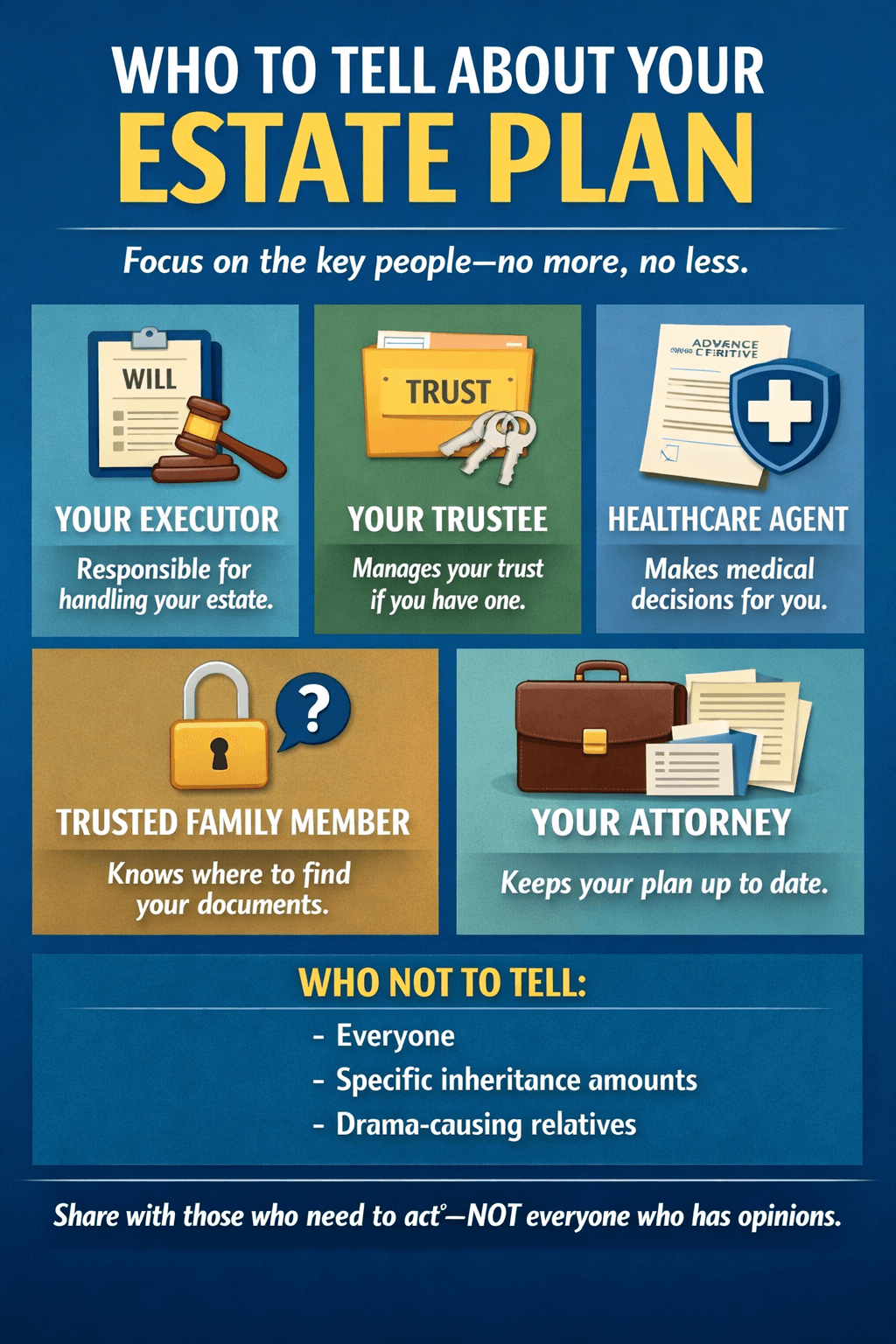
Whom Should I Tell About My Estate Plan?

Creating an estate plan is typically a private matter, not something you share in detail with everyone in your life. After all, what you choose to do with your money and property is your business. Your partner might know what is in your plan, especially if you created it together. But beyond that, does anyone else really need to know?

The short answer is yes. There are good reasons for keeping certain aspects of your estate plan to yourself. However, if you keep too many details to yourself—or forget to keep others in the loop—your well-thought-out plan may not work the way you intended.

An estate plan cannot work if it is invisible. If no one knows that your plan exists or if no one can access your documents, it may as well not exist. Verbal promises carry no weight—simply telling someone about your goals and wishes is not enough. Your wishes must be properly documented.

A Tiered Approach to Divulging Your Plans

Keeping an estate plan private makes sense to an extent. That is why people often use a trust-based plan instead of a will-based plan: The latter is subject to the public probate process, and almost anyone can obtain court records of that process and learn details about you, your family, and what you owned at your death.

Within your family, you may keep your estate plan private to avoid drama and hurt feelings over who will play a role in your plan and who will receive your money and property at your death. Or you may worry that if word gets out about your plan, others’ opinions will sway your decisions. You may instead prefer to make rational, unemotional choices, removed from the competing voices of friends and family who stand to inherit.

While you absolutely have the right to keep your estate plan private, doing so is not always in your best interest. The real question then becomes how do you share something so personal without feeling like you are broadcasting it to the world?

The trick is knowing whom to tell what, when to tell them, why to tell them, and how to tell them. “Telling” someone can mean different things, from giving them copies of all your plan documents and keys to your digital vault to letting them know that they are named in the plan and whom to contact later for more details.

You might use a tiered communication approach that aims to put the right information in the right hands at the right time to prevent confusion, avoid family disputes, and create as little stress as possible for your trusted decision-makers and beneficiaries.

Tier One: Trusted Decision-Makers (Full Access)

Who: The people you have legally appointed to act on your behalf, including:

  • your spouse or significant other (especially if you planned together, share joint accounts or property, or live in a community property state, or if you appointed them to one of the roles below, since they may need to act quickly or coordinate with other decision-makers)
  • a personal representative or executor (carries out the terms of your will and oversees the probate process, if one is needed)
  • a trustee and a successor trustee (manages accounts and property that were or will be funded into the trust according to your trust agreement)
  • an agent under a financial power of attorney (handles your finances, either immediately or, in some cases, only if you are unable to manage them)
  • an agent under a medical power of attorney (makes healthcare decisions if you cannot make them or communicate your wishes)
  • a guardian for minor children (provides care for those who rely on you)

What: Enough information to act immediately and effectively, including:

  • the location of your completed estate planning documents (will, trust, powers of attorney, healthcare directives), including where originals are kept and where copies or electronic versions can be found
  • information on how to access these documents if the originals are stored somewhere such as in a safe deposit box or home safe
  • a list of everything you own (including financial accounts, real property, business interests, digital assets)
  • instructions for special property (for example, businesses, firearms, intellectual property, pets)
  • digital storage location and credentials (secure cloud vault, encrypted drive) for any digital assets (emails, business documents, electronic financial accounts)
  • contact information for your estate planning attorney
  • your wishes and goals, including the choices you have made in your plan and how you want your decision-makers to carry out their responsibilities once they step into their role

You may decide that the agents named in your medical power of attorney are less likely to need detailed financial information. However, they should still know where to access your estate planning documents.

When:

  • as soon as possible after you appoint them to the role
  • any time you appoint new decision-makers or change the order in which you have appointed them to serve
  • whenever you move your estate planning documents to store them in a new location
  • periodically, to confirm that they are still willing and able to serve

Why:

  • they cannot do their job if they do not know they have been appointed and how to access what they need
  • delays in knowing or confusion about who is in charge and where your documents are located can cost money, result in unintended property damage, or cause unnecessary family stress and conflict

How:

  • meet in person or via video to explain their role and your goals and desires
  • provide a written “roadmap” with tasks they will need to perform, a list of everything you own, and key contacts (for example, your financial advisor, attorney, accountant, insurance agent, etc.)
  • store digital copies securely and share controlled access with the relevant decision-makers
  • confirm that they accept the role and understand the responsibilities

Tier Two: Primary Beneficiaries (Selective Access and Strategic Sharing)

Who: The individuals or entities you have chosen to inherit from you upon your passing, even if you have not appointed them to any decision-making role, such as:

  • spouse or significant other
  • children, grandchildren, or other relatives
  • friends or nonrelatives
  • charities or nonprofits
  • religious institutions
  • educational institutions

You may also choose to share your plans with loved ones who might expect an inheritance,  especially if you intend to leave them out, provide for them in other ways (for example, as a direct beneficiary of something or by providing funds to them during your lifetime), or give them less than others in similar relation to you. While the conversation may feel uncomfortable, addressing it now can prevent painful surprises later and ease the burden on your decision-makers and loved ones, who would otherwise be left without your explanation.

What:

  • the nature of the gift (money, real estate, investments, personal property)
  • any obligations attached to the inherited item (taxes, upkeep, management, legal restrictions)
  • their right to refuse the gift (disclaim an inheritance), with the caution that the disclaimer must be made before they take ownership or control of the item

When:

  • the sooner the better if the gift is complex, burdensome, or potentially unwanted
  • more flexibility in timing if the gift is straightforward and unlikely to cause issues—but do not wait until it is too late

Why:

  • prevents surprises that can cause stress or resentment
  • allows time for the beneficiary to prepare for upkeep, sale, or management
  • gives you a chance to reallocate gifts that might otherwise be refused

How:

  • communicate in person, by phone, or in writing
  • explain expectations or conditions attached to the gift
  • for sensitive gifts (disinheritance, unequal shares, heirlooms, pets, business interests), consider having the conversation with your attorney present if you feel uncomfortable addressing it on your own or if you want to create a record of the discussion to demonstrate your intent and legal capacity in the event your plan is contested in the future

Failing to plan—and to clearly communicate your wishes—can have the following serious consequences for your estate:

  • Safe deposit lockout. The executor cannot find your original will and believes it may be in your safe deposit box at the bank, but their name is not on the account, forcing a court order to open it.
  • Forgotten password. Digital estate planning documents are stored in the cloud, but the account credentials were never shared, leaving files permanently inaccessible.
  • Disappearing executor or successor trustee. Your named executor or successor trustee moved away years ago, changed phone numbers, and cannot be reached when needed, and you did not appoint a backup.
  • Unwanted gift. You leave your classic car to a loved one who you know will treasure it as you did. However, they do not have the space or resources to maintain it and reluctantly refuse the gift. If you did not name a backup beneficiary, the car passes to your residuary beneficiaries, who may not value or appreciate it.
  • Long-lost co-owner. If a vacation home left to a nephew is actually co-owned with a distant cousin, your nephew is forced into a joint ownership arrangement that leads to years of awkward and expensive disputes.
  • The “final will” problem. Multiple unsigned drafts are found on the decedent’s desk, with no clear final version. Your loved ones are left to argue among themselves and in court over what your true intent was.

Legal Advice and Establishing a Need-to-Know Basis for Your Plan

Your death is more than an administrative process, but thinking about your estate plan in that way can inform practical choices that make wrapping up your estate smoother for everyone involved.

An estate plan works best when paired with a communication plan that shares the right amount of information with the right people at the appropriate time, balancing privacy with transparency and flexibility.

If you are unsure how to strike that balance, call us to discuss your plan and devise the best strategy for informing your loved ones.

Estate Planning Truths: Debunking Common Misconceptions

Estate planning often feels complex, leading many people to rely on assumptions that can have devastating consequences for their loved ones and their legacy. From who can make decisions for you to whether you need an estate plan, common myths can stand between you and a secure future. Let’s debunk these widespread misconceptions and reveal four essential truths about effective estate planning.

Myth 1: My spouse can make all my healthcare and financial decisions because they are my spouse.

Reality: This is a dangerous misconception that can lead to significant stress and financial hardship for your family. While your spouse has certain rights, they generally do not automatically have the legal authority to make all medical decisions or manage all your financial accounts if you become unable to manage your affairs (i.e., become incapacitated). Without properly executed legal documents, you and your spouse may face obstacles handling the following:

  • Medical decisions. Your spouse may be unable to access your medical information, direct your care, or make critical end-of-life decisions without a medical power of attorney (also known as a durable power of attorney for healthcare) and an advance directive (or living will). Without these documents, a court may need to appoint a guardian or conservator in a public, costly, and time-consuming process.
  • Financial decisions. Similarly, your spouse could be locked out of accounts in your sole name, unable to pay bills or manage investments without a financial power of attorney. This can prevent timely financial management and even payment of day-to-day expenses. As with medical decisions, a court may need to appoint a guardian or conservator before your spouse can access these important accounts.

Proper planning ensures that your spouse or another trusted individual you choose has the immediate legal authority to act on your behalf and honor your wishes without court involvement.

Myth 2: My family knows my wishes. They will divide everything the way I want it divided.

Reality: While your family may genuinely intend to honor your verbal wishes, discussions about your affairs—without proper legal documentation—carry no legal enforceability. After your death, without a legally binding plan, your estate may be distributed according to your state’s intestacy laws, which may not necessarily be what you intended. This could lead to the following outcomes: 

  • Unintended beneficiaries. If you rely on the state’s default distribution plan, your money and property could go to distant relatives rather than close friends, stepchildren, or other nonrelated loved ones.
  • Family disputes. Even well-meaning family members can disagree on what your true wishes were, leading to bitter conflicts and costly litigation that depletes your hard-earned money and property.
  • Loss of control. Without a last will and testament or revocable living trust, you have no say regarding who inherits your money and property and how they receive it, who will raise your minor children, or who will be in charge of winding down your affairs.

A comprehensive estate plan is the only way to legally ensure that your estate is passed on as you intend, protecting your legacy and providing clear guidance for your loved ones.

Myth 3: I signed a will before, so I do not need to do it again.

Reality: Life shifts, laws change, and your goals evolve over time. An outdated estate plan can be just as detrimental as having no plan, so be sure to review your estate plan regularly—ideally, every three to five years. You should also review your estate plan whenever significant life events such as the following occur:

  • Family changes. Such changes include marriage, divorce, remarriage (yours and your children’s), birth or adoption of children or grandchildren, and deaths of beneficiaries or trusted decision-makers (for example, agents under a financial or medical power of attorney, executor or personal representative, or guardian of your minor children).
  • Financial changes. In addition to seeing significant increases or decreases in the value of what you own, you may have purchased or sold real property or businesses, experienced changes in your retirement accounts, or received an inheritance.
  • Location changes. Moving to a different state or country can dramatically impact the validity and effectiveness of your existing estate planning tools, as state and country laws can vary widely.
  • Tax law changes. Estate, gift, and income tax laws constantly evolve at federal and state levels, potentially affecting how your money and property will be distributed, how they will be taxed, and how much a beneficiary may ultimately receive.
  • Changes in goals. Your philanthropic desires, legacy goals, or wishes for specific personal property, accounts, or real property may shift over time. Your estate plan should reflect that.

A comprehensive review of your estate plan every three to five years or after any major life event is crucial for ensuring that your estate planning tools still reflect your wishes, minimize taxes, avoid probate, and align with current legal requirements.

Myth 4: I am not wealthy enough to need an estate plan.

Reality: This myth is perhaps the most dangerous. Almost everyone, regardless of their net worth, can significantly benefit from thoughtful estate planning. While an estate plan certainly addresses your financial accounts, estate planning encompasses far more than just money.

  • Protecting your children. If you have minor children, a will is the primary legal document for nominating a guardian to care for them if something happens to you. Without one, a court will decide who will raise your children—without your input—often through a public and potentially contentious process. 
  • Caring for pets. You can ensure that your beloved pets are cared for after you have passed away or during a time when you cannot care for them.
  • Distributing sentimental items. A personal property memorandum can specify who receives your cherished family heirlooms, artwork, or other nonmonetary items, which can help prevent family squabbles.
  • Planning for your incapacity. A comprehensive estate plan allows you to name trusted individuals to manage your finances, make medical decisions, and carry out your wishes without the delays and expenses of court involvement if you become incapacitated. Such protection is valuable regardless of how much money or property you own.

Estate planning is about taking control, ensuring that your wishes are honored, and providing peace of mind for you and your loved ones, no matter what you own. To learn how estate planning can benefit your specific situation, call us to schedule a consultation.

12 Estate Planning Blunders You Cannot Afford to Make

Many people believe that a simple will is all they need to accomplish their goals for the future. However, a flawed estate plan can create just as many headaches, heartaches, and expenses for your loved ones as having no plan. Life changes, laws evolve, and even the best intentions can fall short, leaving family members facing court battles, unexpected taxes, or painful disagreements. Here are 12 common mistakes that might be hiding in your estate plan that can jeopardize your hard-earned money and property, diminish your legacy, and place unnecessary burdens on your loved ones. Ask yourself: Is my current plan truly ready for the future, or is it time for a review?

  1. Lack of healthcare planning. Most deaths occur in hospitals or other healthcare facilities, where many patients near the end of their life are unable to make or communicate their decisions. Without a plan, families and providers can be left guessing. Advance directives outline your preferences for end-of-life care; healthcare powers of attorney appoint a trusted person to make decisions on your behalf when you cannot. Together, these documents ensure that your medical wishes are honored and can be paired with financial powers of attorney to protect your property and finances during incapacity.
  2. Failure to appoint financial decision-makers. There may come a time when you need someone to manage your financial and legal affairs, either because you are incapacitated or simply unavailable for a specific transaction. A financial power of attorney allows you to appoint a trusted person to act on your behalf, ensuring that bills are paid and important matters are handled without the need for court intervention.
  3. No will or trust. Without proper planning, your estate may be held up in the often long, public, and costly probate process for months or even years after your death, at a great emotional and financial cost to your family. If you have no will, a judge will apply the state’s statutory default distribution plan to determine who will receive an inheritance from you and how much they will receive. This plan may not match your wishes.
  4. Lack of attention to digital assets. Without a plan for your digital assets (such as digital photos, cryptocurrency, nonfungible tokens, social media profiles, content creation accounts, and accounts associated with e-commerce businesses) your loved ones may lose access to critical documents, photos, memories, and other important family records. They may also be unable to access any bank accounts or money associated with or generated by your digital assets or accounts.
  5. Failure to anticipate your children’s possible future divorces, creditors, or lawsuits. Although it is not fun to consider, if your children divorce, rack up massive debt, or are sued at some point in the future, their inheritance could be lost and end up in the hands of unintended people. A trust can help protect your legacy and your children’s inheritance.
  6. Failure to provide for an intentional transfer of family values. Do you want to pass on more than just money to your loved ones? A comprehensive estate plan can include provisions regarding family meetings, a family mission statement, and custom planning for your loved ones so that your values will continue into the next generation. Your custom plan could include allowing loved ones to choose a charity to receive part of your accounts or property, setting money aside for future family reunions or travel, or building in provisions to incentivize major milestones such as getting married or graduating from college. 
  7. Wasted individual retirement account (IRA) funds. Retirement account beneficiaries generally have the option to receive funds in a lump sum, which could result in a massive income tax bill for them. If this is not your intent, it is crucial to properly plan these accounts to minimize potential tax consequences. A standalone retirement trust, sometimes called an IRA trust, can help safeguard retirement funds from premature or imprudent withdrawals as well as from beneficiaries’ creditors and financial predators while still ensuring that those assets are available to support your beneficiaries.
  8. Chaotic record-keeping. Proper planning ensures that your loved ones do not spend months or years trying to piece together your finances or interpret your wishes. A comprehensive estate plan helps you organize your finances and create a clear system for keeping your important documents, financial information, and instructions about your wishes in one place, readily accessible to your loved ones when they need them most.
  9. Failure to consider a surviving spouse’s remarriage, creditors, and predators. If your surviving spouse remarries, your estate could end up in the hands of people you never intended. Likewise, if your surviving spouse is victimized by financial predators—something increasingly common with an aging population—your family may discover too late that your legacy is gone. A trust can help protect your money after you are gone.
  10. Family feuds over sentimental items. Sometimes fights are not just about money. Feuds and infighting among your loved ones can occur over items that have little monetary value but high sentimental value. You can help avoid such conflict with a personal property memorandum that lists who gets special items such as artwork, family heirlooms, and jewelry. In addition to the financial accounts, your plan should include careful consideration of important family items.
  11. Health Insurance Portability and Accountability Act (HIPAA) privacy lockout. If incapacity leaves you unable to communicate, family members—even your spouse—may be unable to access your medical records or talk to your doctors because of HIPAA privacy rules. Signing a HIPAA authorization form ensures that the people you choose can access your medical information.
  12. Outdated estate plan. Does your estate plan reflect your current circumstances, goals, and needs? Have you, your beneficiaries, or your trusted decision-makers had any major life changes (such as getting married, having a child, passing away, divorcing, receiving an inheritance, or moving to a different state)? A comprehensive review by an estate planner ensures that your estate plan reflects current laws and tax rules and carries out your wishes based on your and your loved ones’ lives today. 

Do not leave your family vulnerable to these common oversights. A strong estate plan provides peace of mind, knowing that your loved ones are protected and your wishes will be honored. If you recognize any of the above mistakes in your own plan, or if it has been years since your last review, now is the time to act. Contact us today for a comprehensive review and to create a plan that truly reflects your life and legacy.

While You Are Working on Your Golf Game, Don’t Forget to Work on Your Estate Plan

While You Are Working on Your Golf Game, Don’t Forget to Work on Your Estate Plan

The course stretches out around you, lush and perfectly manicured. You step up to the ball, take a few practice swings, and inhale the morning air. It is a shot you have made hundreds of times. But years of playing golf have taught you that there is no guarantee you will hit it right this time.

Today the breeze is a little stronger. The grass is damp. The same old sand trap guards the flag, daring you to try your luck. You adjust your hands, set your feet, and commit to the shot. You eye the ball and hit it square. Everything feels dialed in . . . until the ball sails into the sand.

Golf, like life, has a way of humbling even the most experienced among us. Conditions change. Variables shift. What worked last time might come up short today.

Estate planning is no different. It is about knowing the terrain, making smart choices with the tools you have, and adjusting as life throws you its fair share of water hazards, wind gusts, and bunker shots.

August is National Golf Month. While you are out there working on your game, remember that in the game of life, you should also be developing your estate plan. As with golf, an estate plan takes careful preparation and continual refinement for the best results.

Teeing Up: Get Your Information Together

There is something to be said for not overthinking in golf—or in estate planning. Overthinking can lead to what psychologists call analysis paralysis.

In golf, analysis paralysis can lead to freezing up and getting a case of the “yips.” You play out worst-case scenarios in your head, which can cause more overthinking, overanalyzing, indecision, and ultimately, poor execution.

The same can happen with your estate plan. You spend so much time agonizing about the initial step that it interferes with the process (or even with getting the process started).

Golf pros recommend that you reduce intrusive, unnecessary thoughts on the course by having an established, repeatable preshot routine. For your estate plan, that process starts with gathering your essentials. Before “teeing off,” know the following:

  • What you own. This includes bank and retirement accounts, investment portfolios, real estate (such as your home, cottage, or rental properties), vehicles, valuable collections, and digital assets.
  • What you owe. Consider your mortgages, loans, and other debts.
  • Whom you would like to name as your beneficiaries. Whom do you want to receive your money and property? Beneficiaries may include family members, friends, and charities.

This inventory is your “yardage book,” so to speak. It gives you the lay of the land. Without it, your estate plan has no direction. With it, you are ready to take a confident first swing.

Selecting the Right Club: Choosing Your Estate Planning Tools

You have teed up and surveyed the course, and now it is time to take your first real swing. Not every shot requires your driver, and not every estate plan needs the same tools.

On the course, picking the right club can make or break your shot. In estate planning, the “clubs” are the tools you use, such as wills, trusts, powers of attorney, and healthcare directives.

You would not reach for a putter on the tee box, and you would not use a driver for a delicate chip shot. Nor would you rely on a bare-bones will to handle complex family situations, accounts, properties, or businesses, or name a beneficiary with special needs on a life insurance form that could jeopardize their government benefits.

Experience is the best teacher. But chances are that you have spent more time on your golf game than on your estate plan. You might be playing the estate planning course for the first time. Your “caddy,” though—that is, your estate planning attorney—knows the course. They are the seasoned professional advisor by your side, helping you evaluate the available estate planning “clubs” and select those that will reliably get you closest to the hole (your planning goals). An estate plan typically has the following goals:

  • Avoid probate and streamline the transfer of your accounts and property after your death
  • Enable someone you trust to make medical decisions for you and manage your finances if you are alive but unable to do so (i.e., are incapacitated)
  • Minimize estate, gift, and income taxes
  • Establish guardianship and financial support for minor children
  • Protect your hard-earned accounts and property from your chosen beneficiaries’ creditors, lawsuits, or future divorces
  • Preserve eligibility for a beneficiary who is receiving means-tested government benefits
  • Leave a lasting legacy through charitable giving or multigenerational planning

With the right advice and the right tools in hand, you will be well positioned to keep your plan on course and headed straight for the green.

The Drive: Signing the First Set of Documents

There are few feelings on the golf course that compare to nailing your first shot. You know you hit it well by the sound of the club strike and the way it launches cleanly off the tee. Your preparation has paid off. You did not overthink—or underthink—the process. The ball arcs through the air, lands in the center of the fairway, and rolls forward. You spot it, smiling as you make your way down the course with a little spring in your step.

In estate planning, signing your initial set of documents, such as a will or trust, is your “drive.” It is your initial shot that moves the ball decisively down the fairway. This “first swing” puts the following key protections in place:

  • Naming who will manage your affairs if you are incapacitated or after you pass away
  • Setting clear instructions for how your money and property should be distributed to your beneficiaries
  • Helping prevent family confusion or conflict at a time when emotions are running high
  • Protecting your minor children by nominating guardians in case something happens to you

Like a strong drive that moves the ball far down the course and sets up your approach to the green, these documents take you much closer to your end goal. They are unlikely to be a “hole-in-one.” There is still work to be done. However, you are much closer than you were when you started. You are no longer standing at the tee, debating your initial swing. You have committed and made measurable progress. You are moving the ball forward.

Putting: Adjusting Your Approach to the Pin

Some golfers are known for having a powerful drive. They look strong coming out of the box. Their ball sails far and true off the tee, and from initial appearances, has set them up for an easy, stress-free finish.

Seasoned golfers understand, though, that the short game is every bit as important as the long game. As the saying goes, “drive for show, putt for dough.”

In estate planning, even the best drive (signing your initial documents) will not get the ball to the pin (planning goals) without a steady hand on the green. Life, like golf, is a game of making ongoing adjustments to changing conditions. Hazards (sand traps, water hazards, trees, wind gusts) pop up. You and your caddy might be ready to deal with these. But what about something totally out of the ordinary (say, a massive alligator interrupting play)?

Each change can alter your path to the pin and the strategy to get there. When conditions change on or off the course, your plan should change too. Situations that call for estate plan adjustments include the following:

  • Marriage or remarriage. You will likely want to update beneficiaries and consider appointing your new spouse as your decision-maker if you become incapacitated or upon your death.
  • Having children or grandchildren. You may want to add them as beneficiaries, appoint guardians, or create continuing subtrusts to hold their inheritances.
  • Divorce. This event should cause you to revisit your entire plan to reflect a new family structure.
  • Death or incapacity of a trusted decision-maker. You should choose new executors, trustees, or healthcare agents.
  • Changes in wealth or business ownership. You will want to integrate any new accounts and property or liabilities into your estate plan and reassess tax exposure.
  • Tax law or legal changes. You should continuously fine-tune strategies to preserve tax efficiency and maintain compliance with updates in all applicable laws.

Long drives in golf are impressive to watch, but the best golfers—and the best estate plans—have both a strong long game and a finely honed short game. Plan regular reviews of your estate plan every three to five years or after any major life event. With a few well-placed and well-timed adjustments, you will stay on track for a smooth finish—no mulligans needed.

Playing the Full 18

You cannot let up on the golf course or on your estate plan. You must stay focused on the course ahead, know your approach, and be ready to adjust on the fly.

Golfers do not come out ahead by playing a few good holes. You could cruise through the front nine and struggle on the back nine. A single disastrous hole can undo an otherwise stellar round. It might look like a perfect day for golf, but conditions can change quickly and unexpectedly.

You cannot always rely on past decisions to carry you to the cup, in golf or in life. What worked before might not work now. Keep refining, improving, and adapting your estate plan the same way you would your golf game. During this year’s National Golf Month, work on more than just your handicap. Take a swing at your estate plan, and make sure it is built to play the full 18 holes on any course and in any conditions. If you need a caddy for your next round, call us.

Is an Income-Tax Time Bomb Lurking in Your Estate Plan?

Is an Income-Tax Time Bomb Lurking in Your Estate Plan?

As the federal estate tax exemption has ballooned from $5 million in 2011 to $13.99 million today, the need for estate tax planning has drastically decreased. However, with a top marginal income tax rate of 37 percent, the focus of estate planning has shifted to a new frontier: income tax basis planning.

The Basics of Income Tax Basis

In its simplest form, income tax basis—often referred to simply as basis—is the original cost to buy an asset (i.e., stock, bond, real property). However, the actual definition is more complex, as basis can be adjusted over time and depends on how an asset was acquired. Basis must be tracked because, when an asset is sold, income tax liability in the form of capital gains tax is assessed on the capital gains, which is calculated by subtracting the basis from the sales price. Basis plays an important role in estate planning in two ways:

  • Carry-over basis. When property is gifted during life, the recipient of the gift receives the donor’s basis in the property, referred to as carry-over basis. For example, if you purchase 100 shares of Facebook stock for $60 per share for a total of $6,000, your basis in the stock is $6,000. If you then gift the stock to your son during your lifetime when the price is $100 per share, your basis of $6,000 “carries over” to your son so that his basis in the stock is $6,000 (even though the fair market value is $10,000). If your son decides to immediately sell the stock for the fair market value, capital gain of $4,000 ($10,000 fair market value less the $6,000 basis) will be subject to capital gains tax. 
  • Basis adjustments. When property is transferred at death, the beneficiary generally receives a basis in the property equivalent to the fair market value on the date of the decedent’s death—a concept known as basis adjustment. Because property tends to appreciate in value and the fair market value of the asset at the date of the decedent’s death is usually more than the decedent’s original basis, most basis adjustments can be referred to as a step-up in basis. For example, if you purchase 100 shares of Facebook stock for $60 per share, your basis is $6,000 (as in the earlier example). However, instead of gifting the stock during your lifetime, you leave it to your son at your death when the stock is worth $100 per share. In this case, the stock receives a step-up in basis, and your son’s basis becomes $10,000, reflecting the fair market value at the time of your death. If your son decides to immediately sell the stock for the fair market value, the sales price will equal your son’s basis, so there will be no gain and no capital gains tax. 

AB Trust Planning: An Income Tax Basis Nightmare for Many Couples

Including assets in a deceased person’s estate is the key to giving beneficiaries an adjusted basis. Yet traditional planning for married couples that uses an AB trust plan deliberately excludes property from the surviving spouse’s estate. An AB trust plan, also known as a marital or QTIP trust, family trust, or bypass trust plan, works as follows:

  • When the first spouse dies, the deceased spouse’s property will be divided so that an amount equal to the federal estate tax exemption will go into the bypass trust (the B trust), and any excess will go into the marital trust (the A trust). For example, if Joe dies in 2025 with an estate valued at $15 million, then $13.99 million (the 2025 federal estate tax exemption amount) will go into the bypass trust, and $1.01 million will go into the marital trust. The assets in both trusts receive a basis adjustment (likely a step-up) as of Joe’s date of death.
  • Joe’s trust provisions will specify whether and how Mary, his wife, receives income and principal from the bypass trust. Similarly, Joe can determine whether and how Mary can receive principal from the marital trust, although she is required to receive all income from the marital trust at least annually. 
  • When Mary dies in 2030, any property remaining in the marital trust will be included in her estate and receive a second basis adjustment (likely a second step-up) as of her date of death. However, property remaining in the bypass trust is not considered part of Mary’s estate and does not receive a second basis adjustment—it keeps the basis as of Joe’s date of death in 2025. Because there is no basis adjustment at Mary’s death, the bypass trust potentially contains an income-tax time bomb.

How to Build Basis Planning into Your Estate Plan

There are several options to choose from if your goal is to maximize basis for your loved ones:

  • Unwind the AB trust plan and instead leave everything outright to your surviving spouse so that the assets will receive a basis adjustment at your death—and again at your spouse’s death, assuming that the assets remain in their estate. The transfer from you to your spouse will likely qualify for the unlimited marital deduction, so your spouse will not owe estate tax at your death. However, it is important to remember that leaving everything to your surviving spouse outright means that the assets will be their property and may be susceptible to creditors, predators, judgments, or claims from a future spouse or partner.
  • Keep the assets in the bypass trust and give the surviving spouse or other beneficiary a general power of appointment. The general power of appointment will cause the assets remaining in the bypass trust at the surviving spouse’s death to be included in their estate, thereby resulting in a second basis adjustment.
  • For a wait-and-see approach to basis planning, allow for the appointment of a trust protector or trust advisor (if they are recognized within your state) in the trust’s terms and grant them the ability to add a general power of appointment to the bypass trust in favor of the surviving spouse. This will cause the assets in the bypass trust to be included in the surviving spouse’s estate at their death, thus resulting in a second basis adjustment.

Your circumstances will impact which option is the best fit. The great news is that there is almost always something that can be done to achieve your estate planning and asset protection goals that involves good basis planning.

Do You Need a Basis Planning Review?

Instead of falling back on the traditional one-size-fits-all AB trust plans, estate planners today must look carefully at each client’s unique family situation, financial position, and potential estate tax liability to determine the appropriate mix of techniques to minimize both estate taxes and income taxes. If it has been a while since you reviewed your estate plan, it may contain an income-tax time bomb. Call us with questions about basis planning and to arrange for a basis planning review.