

Nonjudicial Settlement Agreements: The Good, the Bad, and the Ugly

Some trusts are irrevocable as soon as they are created, which means that, in general, the trustmaker (the person who created and funded the trust) cannot terminate or modify it and take back the money or property that it holds. You may wonder why anyone would want an irrevocable trust, but irrevocable trusts can provide some very important benefits, particularly asset protection, tax minimization, and maintaining eligibility for government benefits. In contrast, trustmakers may amend or revoke a revocable living trust at any time prior to their death, but at their death the trust becomes irrevocable.

Although irrevocable trusts generally cannot be changed, many states’ laws allow interested parties to modify a trust in certain circumstances using a binding nonjudicial settlement agreement—assuming there is no language in the trust document prohibiting their use or providing another way for the trustee and beneficiaries to consent to modifications. In the absence of a statute permitting a nonjudicial settlement agreement, the interested parties under state law, which may include the grantor, the trustee, or the current or future beneficiaries or their representatives, would have to petition a court to modify the trust or interpret unclear provisions. In states where nonjudicial settlement agreements are permitted, their use can avoid the costs, delays, and lack of privacy associated with judicial proceedings.

When May a Nonjudicial Settlement Agreement Be Used?

A nonjudicial settlement agreement is only valid if it does not violate a material purpose of the trust or terminate the trust in an impermissible manner and any modification would have been approved by a court if the parties had petitioned the court. Although there are variations in each state’s statute governing nonjudicial settlements, there are several situations in which a nonjudicial settlement agreement is typically allowed, including the following:

  • Interpretation of the terms of the trust document if they are unclear
  • Approval of a trustee’s report or accounting
  • Authorization or prohibition of certain actions by the trustee
  • Appointment or resignation of a trustee or determination of the trustee’s compensation
  • Transfer of the location where the trust is administered
  • Determination of the liability of the trustee for actions related to the trust

Many states’ statutes also broadly allow a nonjudicial settlement to address any matter that a court otherwise would resolve. A nonjudicial settlement must be signed by all interested persons to be valid.

Examples

  1. Assume Mike creates a trust for the benefit of Marcia, Jan, Cindy, Greg, Peter, and Bobby and names Carol as trustee. The trust document does not name a successor trustee and does not specify a method for naming a replacement trustee. On a trip to Hawaii, Mike and Carol are killed in a car accident after they find a mysterious tiki idol thought to bring bad luck to whoever touches it. The beneficiaries, who are all adults, may enter into a nonjudicial settlement agreement to appoint a new trustee.  
  1. Assume Morticia creates a trust naming her husband, Gomez, as trustee, and leaving one half of the funds in her savings account to each of her children, Wednesday and Pugsley. Unfortunately, before Morticia passes away, Wednesday dies in a freak accident while trying to teach Lurch to dance, leaving three of her own adult children. The trust does not clearly state whether Wednesday’s one-half share of the savings account should go to her children; the funds should be split equally, with Pugsley and Wednesday’s three children each receiving one-fourth; or all of the funds in the savings account should go to Pugsley. Pugsley and Wednesday’s three children, who are all adults, may enter into a nonjudicial settlement agreement in which they mutually consent to an interpretation of the terms of the trust regarding distribution. It is important to note that gift tax consequences result when value shifts from one beneficiary to another. However, a settlement resulting from a bona fide dispute or litigation should be treated as a transfer for full and adequate consideration and not a gift for gift tax purposes.
  1. Assume that Homer and Marge own a snow plow business that their son Bart has been operating for twenty years. However, Homer and Marge’s trust leaves everything, including the business, to all of their children—Bart, Lisa, and Maggie—in equal shares. The business was the main piece of property owned by the trust. After Homer and Marge pass away, Bart wants to purchase the business and fund Lisa and Maggie’s shares with the proceeds of the sale. Bart, Lisa, and Maggie, who are all adults, may enter into a nonjudicial settlement agreement agreeing to deviate from the original distribution specified in the trust document. 

What Are the Downsides to a Nonjudicial Settlement Agreement?

Possible tax consequences. If a nonjudicial settlement agreement changes a trust’s distribution provisions or the beneficiaries’ interests, the change may result in transfer or income tax liability. For example, if a modification shifts a beneficial interest in the trust to a beneficiary who is a generation younger than the prior beneficiary, liability for the generation-skipping transfer tax may occur. If a nonjudicial settlement agreement involves the transfer of an interest in property to another beneficiary, for example, to settle a dispute, gift tax liability may arise. Certain modifications may also have income tax consequences. It is also important to keep in mind that some states impose their own inheritance taxes on certain transfers to relatives or third parties, which should be considered.

May be contrary to your loved one’s intentions. The trustmaker may have had strong feelings about how the money and property transferred to the trust should be handled, and a modification or termination of the trust pursuant to a nonjudicial settlement agreement may not be what they would have wanted. For example, terminating a trust prior to the original termination date because the beneficiary needs the funds for daily living expenses may not violate a material purpose of the trust; but, if the trustmaker thought the beneficiary was too immature to handle the funds before a certain age, they would not want the trust to terminate early.

We Can Help

If you are the beneficiary or trustee of a trust with provisions that are confusing or incomplete, or if circumstances have changed since the trust document was drafted that make its application difficult or impossible, a nonjudicial settlement agreement may be able to resolve those issues. Call us today so we can meet to discuss these or other issues that you have encountered in the administration of a trust.

Ways Your Will Can Be Revoked

A will (which should be accompanied by other important documents such as healthcare and financial powers of attorney, as well as an advance healthcare directive) is a foundational estate planning document. However, according to Gallup, only 46 percent of US adults have a will. This number has remained consistent in Gallup polls dating back to 1990. If you are among the minority of Americans with this crucial estate planning document, then you probably recognize the risks of not having a will. 

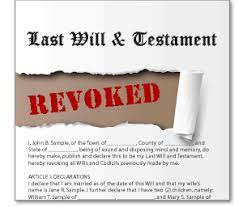
But simply creating a will does not mean that your estate plan is complete or final: your will may need to be updated from time to time. It may even need to be revoked and redrafted entirely. 

Usually, revoking a will is a purposeful act on the part of the will maker. But many states have laws that automatically revoke a will, or portions of it, in specific situations. Certain actions by a beneficiary can also revoke that person’s interest in the will. 

What Is in a Will?

A will—more formally known as a last will and testament—provides instructions about who should receive a person’s money and property after the person’s death and who they would like to care for their dependents. A basic will should specify the following: 

  • who receives personal assets (e.g. property, bank account balances, investments, business interests, and personal possessions) and in what amount 
  • an executor or person responsible for making sure that instructions in the will are carried out
  • guardian arrangements for minor children

When a person passes away, their will goes through a legal process called probate, usually in a probate court located in the county where they lived, although a different location may sometimes be required if, for example, the deceased person owned real estate in another county or state. But if a person dies intestate, meaning without a will, the court must follow state laws that control the distribution of a person’s assets and the appointment of executors and guardians. 

Most people want to make their own decisions about such important matters rather than leaving them to the state. Yet state law will determine what will happen if a person does not have a will. 

Creating a basic will does not have to be expensive or time-consuming. A will should be updated as life circumstances dictate. Many people change their will when they get married or divorced, have a child, accumulate more wealth, buy new property, retire, or move to another state or country. The will maker might also have a change of heart about beneficiaries or a guardianship arrangement due to a personal falling out or changes in the circumstances of a beneficiary or potential guardian. 

Estate planning attorneys generally recommend revisiting—and possibly updating—a will every few years. Even if the person who created the will has not experienced a major life event, periodic reviews are essential to ensure that the will still accurately represents their intentions and relevant law. 

Updating an Existing Will

Amendments to a will are made using a legal document called a codicil. Like the execution of a will, executing a codicil usually requires that the person who is creating or changing their will sign the will or codicil in the presence of at least two witnesses. 

Codicils are something of an anachronism dating to the time before computers, when drafting a new will by hand was more onerous. Nowadays, it is easier than it used to be to create a new will that contains the amended portions. The American Bar Association also cautions that codicils can lead to confusion or legal challenges if they create ambiguities when read together with the provisions in the original will. 

Using a codicil to make minor changes to a will—such as changing the executor—does not necessarily revoke it. However, in some states, a codicil can be used to republish or revoke a will. 

Executing a New Will

Your estate planning lawyer may advise you that a codicil is not worth the potential problems it can cause and instead recommend that you make a new will. The new will must be properly executed in accordance with state law. In addition, the will should contain language that clearly states the will maker’s desire to revoke all prior wills. However, there may be instances in which the will maker does not want all prior wills revoked (e.g., they may need to have a separate will for property owned in a foreign country). 

Destroying an Old Will

The fastest way to revoke a will is to physically destroy it. States have different definitions of what qualifies as the destruction of a will. Usually, the state statute includes some variation of the phrasing that a person can revoke their will by “cutting, tearing, burning, obliterating, canceling, destroying, or mutilating” it. Note that this definition does not include making notes in the margin or placing an “X” through part of a will. 

Most state laws provide that the destruction must be done with the intent and for the purpose of revocation, so accidentally destroying a will may not revoke it. 

Electronic wills may have different definitions for revocation by destruction. Florida, for example, says that an electronic will or codicil is revoked when it is deleted, canceled, rendered unreadable, or obliterated. 

The law may allow the will maker to direct another person to physically destroy a will on their behalf, provided that the will maker is there to witness it. State law may also require the presence of two additional witnesses. Depending on the state, there could be a presumption that the will was destroyed if it cannot be located. However, most states have processes by which lost wills may be proven by using copies and one or more disinterested witnesses. If the intent is to revoke a will, it is best to consult an experienced estate planning attorney.

If the destruction of a will does not comply with the requirements of state law, the court may rule that it was improperly destroyed and treat it as though it is still in effect. Typically, when somebody destroys an old will, they make a new will. But if the old will is not legally revoked, and a new one is created, the existence of multiple wills could lead to litigation. 

Revoking a Will by Operation of Law

State law may provide that a will is revoked, in part or in full, if certain events take place, such as the following: 

  • If a person gets divorced or has their marriage annulled, any part of the will that refers to their spouse, or the spouse’s family, is automatically revoked in many states. 
  • There is a new will or codicil that includes provisions that contradict provisions in old will or codicil. 
  • A beneficiary’s interest is revoked under a “slayer statute” if the beneficiary kills the will maker. 

Thinking of Changing Your Will? Talk to an Estate Planning Lawyer

Whether you are making minor changes to your will or destroying the old one and starting from scratch, any revocation of your will must comply with state law. Otherwise, a court might not recognize your final wishes, which can produce consequences akin to not having a will at all and cause your loved ones additional stress and potential conflict. 

An estate plan should be updated every few years to take into account new milestones and directions as well as changes in the applicable law. To discuss changes to your estate plan, please contact us to schedule an appointment.


Footnotes

  1. Jeffrey M. Jones, How Many Americans Have a Will?, Gallup (Jun. 23, 2021), https://news.gallup.com/poll/351500/how-many-americans-have-will.aspx.
  2. Introduction to Wills, Am. Bar Ass’n, https://www.americanbar.org/groups/real_property_trust_estate/resources/estate_planning/an_introduction_to_wills/ (last visited Feb. 24, 2023).
  3. Fla. Stat. § 732.506 (West, Westlaw through 2022 Reg. Sess. and Spec. A, C, and D Sess. of 27th Legis.), http://www.leg.state.fl.us/statutes/index.cfm?App_mode=Display_Statute&Search_String=&URL=0700-0799/0732/Sections/0732.506.html.

Have You Chosen the Right Trustee?

Whether you are reviewing your existing trust or creating a new trust, you should understand the important role that a trustee plays not only in handling trust matters but also in providing for and protecting your loved ones.

What is a trust?

A trust is an agreement between an owner of accounts and property (trustmaker) and another person (trustee) who agrees to manage the accounts and property on behalf of a third party (beneficiary). In most situations, there is a written document, called a trust agreement, that lays out the specific instructions or rules that govern the trust relationship. 

What is a trustee?

A trustee is a trusted decision maker who is tasked with handling all matters that relate to your trust. Depending on the type of trust, you could be the trustee in the beginning and need someone else to act as trustee only when you are unable to manage the trust, or you could select a trustee to act immediately.

What types of trustees are there?

When creating an estate plan, there are several types of trustees to consider. An initial trustee is the decision maker that immediately starts managing the trust’s accounts and property. You may choose to be the initial trustee if you create a revocable living trust. However, for some types of irrevocable trusts, you will need to select someone else to be the initial trustee. 

The successor trustee is the next in line to manage the trust. This person may need to act because the initial trustee becomes incapacitated, dies, or steps down from their role. 

You could choose to have one trustee handle the entire trust. You could also choose to name a separate trustee for any subtrusts that you later create. For example, you may name your children as the trustees for the subtrusts that are created for their benefit at your death. In this instance, there may be several trustees acting once the subtrusts are created. However, they will only be responsible for their separate trust and will have no control over other subtrusts that have their own trustees.

What does a trustee do?

Being a trustee involves many different important tasks, including the following:

  • Managing accounts and property owned by the trust or subtrust. Although the trust owns your accounts and property, a person needs to carry out most transactions. If the trust owns an investment account, the trustee must watch the investments and request any adjustments that may be needed to ensure the best outcome for the trust and its beneficiaries.
  • Keeping the trust beneficiaries informed about the trust. Although the trustee decides how trust accounts and property are used, they do so on behalf and in the best interests of the trust beneficiaries. A trustee is required to periodically inform the trust beneficiaries about the status of the trust—what the trust owns, how much the trust is worth, what income the trust has received, and what expenses the trust has paid.
  • Acting as a point person for trust matters. If beneficiaries have questions about the trust, the trustee is usually best suited to answer them. The trustee is also in charge of filing tax returns and participates in any lawsuits involving the trust.

What should you look for when selecting a trustee?

While it may be advantageous for a trustee to be financially savvy or have a background in tax, law, or finance, they are not required qualifications. When considering potential trustees, we recommend looking for someone with following qualities: 

  • Ability to ask for help when needed. The trustee does not have to be an expert in every area of trust administration. They can get assistance from financial advisors, tax preparers, and attorneys at the trust’s expense to fully carry out their responsibilities.
  • Be detail oriented. Trust administration is a process with specific legal steps that must be taken. The trustee will be asked to compile a list of everything that the trust owns and keep accurate records of income and expenses. Being too general with this information can cause tension between the trustee and beneficiaries and could lead to legal action.
  • Be organized. Depending on what the trust owns, how many beneficiaries there are, and the trust distribution plan, there may be a lot of moving parts. In addition to managing the trust, the trustee will need to make sure that they do not mix their personal affairs with those of the trust.
  • Have good communication skills. Although the trustee has authority over the trust, they are supposed to act in the best interests of the beneficiaries. It is important that the trustee clearly communicate with the beneficiaries, deliver necessary information, and be available to answer any questions that the beneficiaries may have in a timely manner. A trustee must also be able to get along with the beneficiaries.
  • Follow rules. State and federal laws, as well as instructions within the trust, must be followed. While a trust may have provisions that allow a trustee to use their discretion in some matters, there are other instances in which the trustee is required to do certain things a specific way. Failing to comply with the rules can subject the trustee to potential civil and criminal penalties.

Who can you choose to be your trustee?

Although the choice of trustee is a very serious matter, you have several options available to you depending on your circumstances and what matters most to you.

  • Family members. It is common for clients to select family members (spouse, child, parent, sibling, etc.) to be their trustees. Family members likely have an intimate knowledge of your wishes and values, making trust administration easier if you want to leave decisions to your trustee’s discretion. If your trustee is also a beneficiary, they could choose not to accept any compensation for acting as trustee because they will already be receiving something as a beneficiary of your trust. However, allowing the beneficiary to be the trustee of your trust could jeopardize or limit protection of their inheritance.
  • Close friends. Close friends likely understand your values and wishes, making any discretionary decisions easier; however, depending on your family dynamics, your close friends may not want to get involved in any conflicts that arise. Also, if they are not trust beneficiaries, they may want to be compensated for the work they do, which could leave some beneficiaries feeling disgruntled that your trustee is getting money from the trust (even though the trustee is legally entitled to it).
  • Professional third party. If protecting your beneficiaries’ inheritances is important to you, a professional may offer additional protection. Because administering trusts is their profession, they will likely understand every step that must be taken and have the tools to efficiently and accurately do so. However, because trust administration is their job, they will require compensation and will inform you of their fee. This amount will likely be higher than what a family member or close friend would seek for compensation.

We understand that you have an important decision ahead of you. We are here to guide you through the decision-making process and answer any questions you may have along the way. Call us to schedule an appointment so we can help you check this item off your to-do list.

Disability Panels to Take Back Control

When you create an estate plan, it is an admission of your mortality. But even if you accept that you are not going to live forever, you may be slower to face the possibility that you could become incapacitated before you die. 

Although it can be an uncomfortable topic, incapacity is an essential but often overlooked part of drafting revocable living trusts. Placing your money and property in a living trust can accomplish many estate planning objectives, including planning for incapacity. Should you suffer a disability, your mental competency could come into question. At that point, it will need to be determined if a backup trustee should take over the management of your living trust. 

Who, exactly, makes this key determination is very important. Naming a disability panel in your trust allows you to exert control over your incapacity plan by choosing a group of people you trust to determine if you are incapacitated. 

Disability Is Common among Older Americans

Today, Americans can expect to live longer than previous generations. Living longer does not always mean living better, though. 

Older Americans are much more likely than younger Americans to have a disability, according to the Pew Research Center. About one-quarter of Americans, and roughly half of Americans over age seventy-five, report living with a disability. For eighteen- to thirty-four-year-olds, that number is just 6 percent. Around 13 percent of thirty-five- to sixty-four-year-olds say they have a disability. 

Disability can befall anyone at any age. However, the longer you live, the more likely you are to suffer from a disability, and certain disabling conditions such as Alzheimer’s are age-related. Currently, more than 6 million Americans are living with Alzheimer’s. By 2050, the number of Alzheimer’s patients is projected to more than double to 13 million. Roughly one-third of seniors die with Alzheimer’s or another form of dementia. 

Living Trusts and Disability Panels

A living trust, also known as a revocable trust, is a popular estate planning tool that allows people to avoid probate; eliminate, defer, or lower estate taxes; and distribute money and property to their beneficiaries at death. 

Another major benefit of living trusts is that they help the trustmaker (i.e., the grantor, trustor, or settlor) arrange for the management of the trust’s money and property should they become disabled, ill, or the victim of age-related decline. 

The trustmaker is typically also the trustee of their living trust and handles any administration that may be required, such as recording trust income and expenses and filing tax returns. There may be a co-trustee (e.g., a spouse) who shares these duties. If there is no co-trustee who can continue to manage the property held by the trust, a successor trustee named in accordance with the trust document should take over as trustee when the trustmaker dies or becomes incapacitated. It is possible for the trustmaker to name two different individuals to serve as the successor incapacity trustee (upon the trustmaker’s incapacity) and successor death trustee (upon the trustmaker’s death). 

Within a living trust, a trustmaker can define when they are deemed to be incapacitated so there are no doubts about when trusteeship passes from the trustmaker as trustee to the remaining co-trustee or successor trustee. For example, the trustmaker could include a general definition in their trust stating that incapacity begins when they are no longer able to manage their financial affairs; or they could rely on a more objective measure, such as the General Practitioner Assessment of Cognition screening test, which is often used to evaluate dementia patients. 

In addition to defining incapacity, the trustmaker can choose a group of people to determine if the definition has been met. The trust documents can leave this decision to a doctor or the court, or the trustmaker can instead name a private disability panel. 

A disability panel is a group of pre-selected people who determine if the trustmaker is incapacitated. The trustmaker selects these people ahead of time and names them in the trust. The trust should also state whether the panel’s decision must be made by a unanimous or majority vote. 

Reasons to Name a Disability Panel

A physician or court, while ostensibly qualified to weigh in on disability, may not be best suited to the task. The trustmaker may prefer to name a disability panel because 

  • it can include the people who know the trustmaker best and can recognize when something is wrong, 
  • they may feel more secure with a mix of people—such as medical professionals and trusted family members—making the determination, 
  • it eliminates the need to pay an attorney to go to court to have the trustmaker declared incompetent, and 
  • it circumvents red tape and avoids delays that can affect estate planning considerations. 

Creating an estate plan is all about taking control of the future. Naming a disability panel gives the trustmaker control over not only what happens upon their death, but also what happens if they suffer from an incapacitating disability. By providing for a disability panel in their trust, they will not have to rely solely on a court or a doctor to make such a personal decision. 

Getting the Details Right in Your Estate Plan

Advanced healthcare directives and powers of attorney supplement your living trust and can provide direction if you become incapacitated, but if you do not have a disability panel as part of your trust, you are overlooking an important aspect of incapacity planning. 

The people on—and the rules of—your disability panel are completely up to you. Setting these parameters while you are still competent and in control is one more way that you can make your wishes known. 

It is important to discuss the creation of a disability panel with an attorney who can help you with practical considerations, such as having a medical professional on the board to assure stronger cooperation from financial institutions. Remember that you can always change the terms of your revocable living trust, including the disability panel. For help drafting or updating your estate plan, please reach out to schedule a meeting.


Footnotes

  1. Kristen Bialik, 7 facts about Americans with disabilities, Pew Research Ctr. (July 7, 2017), https://www.pewresearch.org/fact-tank/2017/07/27/7-facts-about-americans-with-disabilities/.
  2. Alzheimer’s Ass’n, 2022 Alzheimer’s Disease Facts and Figures, https://www.alz.org/media/Documents/alzheimers-facts-and-figures.pdf.

Why Deathbed Planning Might Give You Additional Grief

None of us likes to think about our own death or enjoys planning for that occasion. However, if you do not create an estate plan or fail to update it regularly, you are likely setting your loved ones up for even more stress and grief after you pass away. It may add to your own stress and impede your peace of mind during your lifetime because of the uncertainty that your wishes and goals will be fulfilled. If you have not updated your estate plan to include loved ones who are not provided for in your existing plan, you may be tempted to make deathbed gifts. It may bring you pleasure to make significant gifts to loved ones because of the joy it may bring to them. However, in addition to the obvious problem that none of us knows the exact time we will die and may not be able to make the deathbed gifts we intend, there are some other drawbacks to deathbed planning that you may not have thought about.

Lack of Basis Adjustment

Although it may seem special and meaningful to provide a gift to a loved one as your last act, it may come with significant costs to them. Under federal tax law, a capital gain occurs if property is sold or exchanged for more than its original price. The original price is called its basis. If you make a gift during your lifetime, even one minute prior to your death, the recipient of your gift will have the same basis you had: this is called a carryover basis. However, if the same person inherits the property after your death, the basis of the property is generally its fair market value at the time of your death: this is called a basis adjustment. This is important because if the value of the property increased over time, it will likely be worth more at your death than it was when you bought it, perhaps many years ago.

Example: If, on your deathbed, you decide to give your son a valuable painting you purchased in 1975 for $20,000 that is currently worth $150,000, the painting has appreciated in value by $130,000. Your son’s carryover basis in the painting is the same as yours—$20,000. As a result, if your son decides not to keep the painting and sells it for $150,000, the increase in value of $130,000 will be taxable as capital gain to him. In contrast, if your son inherits the painting at your death, his basis will be stepped up to $150,000, its fair market value on the date of your death. If he immediately sells it, he would have no capital gain, and thus, would benefit from significant tax savings.

Possible Inclusion in Your Gross Estate

If you have a very large estate, you may be tempted to make lifetime gifts as a way of decreasing the size of your estate and minimizing your liability for estate taxes. However, if you wait until you are on your deathbed to make those gifts, they will still be included in your estate under some circumstances because they are not considered “completed” gifts under federal tax law.1 A recent case, Estate of DeMuth v. Commissioner,2 dealt with a situation in which a father’s health began to worsen. His son, as his agent under a power of attorney, wrote eleven checks on September 6, 2015, from his father’s investment account totaling $464,000 to different recipients in an effort to take advantage of the annual gift exemption ($14,000 in 2015). The father died on September 11, 2015. Some of the recipients had deposited their checks before the father’s death, but some had not. 

Treasury Regulation § 20.2031-5 provides that the “amount of cash belonging to the decedent at the date of his death, whether in his possession or in the possession of another, or deposited with a bank, is included in the decedent’s gross estate.” The Tax Court found that under Pennsylvania law, which was applicable to determine when the gift of a check was a completed gift, delivery of a check does not complete the gift.3 Instead, only checks deposited by the recipients before the father’s death and credited to the their bank were completed gifts, and those that were not deposited or paid by the investment company should be included in the father’s estate because he (or his son as his agent) could have stopped payment on those undeposited checks until his death.4 Estate of DeMuth highlights the importance of planning ahead rather than waiting until the last moments or days of life to make a gift, particularly if the goal is to reduce your estate tax liability.

Although gifts made within three years of your death are generally includible in your estate,5 there is an exception if a gift tax return was not required to be filed because the value of the gift was less than the annual exclusion amount. Transfers relating to life insurance policies, however, are an exception to this exception.6

Doubts about Your Capacity

To make a valid gift, you must have the mental capacity required by state law, but those standards vary by state. In some states, it is the same standard that must be met to make a valid will: (1) you must have a general understanding of what type and how much property you own, (2) you must understand to whom you plan to give the property, and (3) you must understand that the gift transfers the property. In some states, it may also be necessary for you to have an understanding of the effect of the gift on your future financial security. 

If you make a gift on your deathbed, other heirs who may have inherited the property if the gift had not been made and who disagree with your decision may question your mental competency to make the gift. Although the mere fact that a gift was made on your deathbed is not enough on its own to show that you lacked the capacity to make the gift, there may be other factors that call the validity of the gift into question: Could your medical condition at the end of your life cause your mental capacity to decrease? What if you are taking medications immediately prior to your death that could impede your understanding?

We Can Help You Plan Ahead

The downsides of deathbed planning can outweigh any benefits you may think it will achieve, so it is prudent to consult an experienced estate planning attorney when considering any plan involving lifetime gifts. In addition, creating an estate plan designed to achieve all of your goals or updating an old plan that is no longer in line with your wishes will spare your family members and loved ones discord and can help them avoid tax bills. In addition, you will have the peace of mind that comes with knowing that your intentions will be carried out. Give us a call so we can assist you in planning ahead to avoid additional grief for you and your family.


Footnotes

  1. See I.R.C. § 2035(c)(3); Treas. Reg. § 25.2511-2(b) (“[I]f upon a transfer of property (whether in trust or otherwise) the donor reserves any power over its disposition, the gift may be wholly incomplete, or may be partially complete and partially incomplete, depending upon all the facts in the particular case.”).
  2. 124 T.C.M. (CCH) 22 (2022) (appeal filed).
  3. In re Mellier’s Estate, 182 A. 388, 389 (Pa. 1936).
  4. Several of the checks that the Internal Revenue Service (IRS) had mistakenly conceded were not included in the father’s gross estate were excluded from it. But for the IRS’s mistake, the amounts of those checks also would have been included.
  5. I.R.C. § 2035(a).
  6. I.R.C. § 2035(c)(3).
Woman sitting in a field

What You Need to Know About Beneficiary-Controlled Trust

Would you like to provide your children or loved ones with an inheritance but protect them from the risks that may accompany a large windfall? If so, you can create a beneficiary-controlled trust in which the person you name as the trust’s primary beneficiary has rights, benefits, and control over the property held by the trust, but with important protections. In a beneficiary-controlled trust, you can name the primary beneficiary as the sole trustee, or if you name a co-trustee, the beneficiary can be given the authority to remove the co-trustee and select a successor co-trustee if they choose. In addition, a beneficiary-controlled trust may include a broad, non-general power of appointment that enables a beneficiary who is also trustee to limit the ability of other more remote beneficiaries to enjoy the property held by the trust. 

What Are the Pros?

If you want to provide an inheritance to a mature child or loved one that you trust to make prudent financial decisions, a beneficiary-controlled controlled trust is a strategy that you should consider. Even beneficiaries who handle money wisely could encounter situations in which their money and property are vulnerable to creditors’ claims, divorce, lawsuits, or estate taxes: a beneficiary-controlled trust can protect the property held in the trust against those claims. Although you can include terms in the trust document that limit the degree of involvement and control you would like the beneficiary to have, a beneficiary-controlled trust can still enable the beneficiary to have a considerable amount of control over their inheritance and how it is used.

Beneficiary as sole trustee. Under most states’ laws, even if a beneficiary is the sole trustee, most creditors may not reach the beneficiary’s interest in the trust or compel the trustee to make a distribution if the trustee is not required, but has the discretion, to make distributions based on an ascertainable standard, for example, distributions for the beneficiary’s health, education, maintenance, and support (HEMS). Also, even if a beneficiary is the sole trustee, the trustee has a fiduciary duty to adhere to the trust’s requirement to make distributions only for the beneficiary’s HEMS and is not permitted to make distributions to the beneficiary’s creditors. However, once the trustee makes a distribution to themselves as a beneficiary, the creditor may then be able to reach the funds.

This type of provision provides two additional benefits. First, the HEMS standard provides a safe harbor under the Internal Revenue Code (I.R.C.), and its use will prevent the value of the money and property in the trust from being included in your beneficiary’s gross estate for estate tax purposes. Second, depending upon the unique circumstances of each beneficiary and if there is low risk of creditors’ claims or lawsuits, naming the primary beneficiary as the sole trustee, along with the HEMS standard for distributions, may reduce expenses during administration of the trust because the fees required for an independent co-trustee would not be incurred.

Beneficiary as co-trustee. Another option that provides enhanced protection for the trust’s assets such as money and property is to name the beneficiary as a trustee authorized to manage and invest the trust’s assets, and to name an independent co-trustee (sometimes called a distribution trustee) who is responsible for making discretionary trust distributions to the beneficiary. Although it is more complicated and expensive to include an additional independent trustee empowered to make distributions in their sole discretion, it provides a greater degree of asset protection for property held by the trust and for the primary beneficiary indirectly. In addition, the independent trustee does not need to be limited to distributions according to the HEMS standard. Rather, the independent trustee may distribute trust property to the beneficiary for any reason without reducing the level of asset protection. Typically, the trust’s terms still provide the beneficiary with a significant degree of control, not directly over the amount or timing of distributions, but over who serves as the independent co-trustee. The beneficiary is permitted to select the independent trustee as long as that trustee is actually independent—not a related party or a person subordinate to the beneficiary as defined by I.R.C. § 672(c)—and still avoid having the property held by the trust included in their estate for estate tax purposes. In addition, the beneficiary may replace the independent trustee at any time and for any reason. If the beneficiary is facing a heightened risk of lawsuits, divorce, or creditors’ claims, they could resign as the trustee and appoint an independent trustee to serve in their place, providing additional protection for the trust’s assets.

What Are the Cons?

May not protect against all creditors. Some states’ laws provide exceptions that preclude beneficiary-controlled trusts from being used to protect trust assets from claims by certain creditors, for example, a former spouse’s claim for alimony or a claim for child support. In those states, the creditor may be able to reach the trust’s property to satisfy those claims or to compel a distribution that it can then use to satisfy the claims.

May provide too much control for some beneficiaries. For beneficiaries who are not skilled at managing money or have poor judgment, a beneficiary-controlled trust may not be the best estate planning strategy. Although the trust document will specify the beneficiary’s responsibilities as a fiduciary, a beneficiary-controlled trust provides the beneficiary with considerable control over their inheritance. Even if a beneficiary who is also the sole trustee may only make HEMS distributions to themselves, to a large extent, it is up to them to determine if a particular distribution meets that standard, permitting them substantial leeway in how the money or property held by the trust is expended. If you are concerned that a beneficiary will not be able to handle the responsibility of also being a trustee for a beneficiary-controlled trust, other estate planning solutions may provide you with more peace of mind.

If you would like to find out more about whether a beneficiary-controlled trust is a strategy that will work for you and your family, give us a call to set up an appointment. We can help you think through how to design your beneficiary-controlled trust in a way that achieves your goals and protects the inheritance you want to leave for family members and loved ones.

Field with tree and bench

Three Things You Need to Do When Your Spouse Dies and Their Will or Trust Has a Disclaimer Provision

Losing your spouse is one of the most difficult things you might face in life. Although it is important to take time to grieve, there are also some crucial steps you need to take as soon as possible to address your spouse’s accounts and property and secure your own future. 

If your spouse’s will or trust, or your joint trust, has a disclaimer provision, one of the time-sensitive decisions you will need to make is whether to disclaim (refuse to accept) money or property that you will otherwise receive as a trust beneficiary. State and federal law set forth the requirements that you must meet in order for the disclaimer to work as intended. Under Internal Revenue Code (I.R.C.) § 2518, a qualified disclaimer is simply an irrevocable, unqualified refusal to accept a gift or bequest of a property interest. The disclaimer allows the interest in property to pass to someone other than the beneficiary who originally would have received it, and it is not considered a taxable gift from the first beneficiary to the next beneficiary in line. There is a special exemption under I.R.C. § 2518(b)(4) that allows a surviving spouse to benefit from disclaimed money or property, but taking advantage of the exemption requires careful planning. 

A qualified disclaimer must meet the following requirements:

  • It must be made in writing as required by state law.
  • It must be made within nine months after your spouse’s date of death.
  • You must not accept the property interest or its benefits. 
  • The interest must pass to someone other than you without any direction by you (the person who is disclaiming the interest).

There are several steps you should take to ensure that you make timely decisions and properly disclaim a property interest if you choose to do so:

Step 1: Locate the estate planning documents. Your estate planning documents are one of the first sources of direction about what should happen next. Your spouse’s documents contain the roadmap that indicate what your spouse wanted to happen to their property and money, and they were likely designed in coordination with your own estate plan. A will or trust may include a provision specifying how particular property should be handled if the original beneficiary disclaims their interest in it. Your estate planning attorney will need to have those documents to advise you about the best course of action. 

Step 2: Meet with your estate planning attorney. The legal process that those who are left behind when someone dies is often complicated, and it is important to seek the help of your estate planning attorney. Because of the limited time during which you must elect to disclaim accounts and property, you will need to make an appointment with your attorney as soon as you can. Your attorney will review your spouse’s estate plan with you and help you determine if it contains disclaimer provisions, and if so, whether you should consider disclaiming your interest in a will or trust and the effect of such a disclaimer. 

Because of the unlimited marital deduction under federal tax law for US citizens, your spouse was permitted to transfer an unrestricted amount of accounts and property to you at any time during their life or at their death, free of taxes. However, the transferred amounts will usually be included in your estate. If you and your spouse had a large amount of wealth, using a disclaimer is one strategy for taking advantage of the lifetime estate tax exemption. 

Currently, the exemption amount is historically high. In 2023, the federal estate tax exclusion amount is $12.92 million for an individual and $25.84 million for a married couple, and only estates that exceed this amount are subject to estate tax. However, the current estate tax exclusion amount is scheduled to be reduced by half at the end of 2025, so many more estates will soon be subject to estate taxes unless the law is changed. In addition, some states have their own estate or inheritance taxes applicable to estates of a much lower value. If your estate is likely to be subject to federal or state estate taxes, disclaiming an inheritance may make sense, especially if the beneficiary specified in the trust document as the next in line is less likely to be subject to estate taxes, or if the trust specifies that the disclaimed property can be transferred to another trust that will benefit you without being included in your estate. 

Keep in mind, however, that for federal estate and gift taxes purposes, after your spouse’s death, you must file an estate tax return and make a portability election that will allow your deceased spouse’s unused exclusion amount (known as the deceased spousal unused exclusion (DSUE) amount) to be applied to your subsequent transfers during life or at death. For example, if your spouse’s gross estate is valued at $5 million and does not qualify for the unlimited marital deduction, you can elect to have their unused estate tax exemption of $7.92 million transferred to you. As a result, your estate would have a total exemption of $20.84 million ($12.92 million plus $7.92 million) in 2023, so a disclaimer may not be necessary unless you and your spouse have very large estates. 

Your estate planning attorney will help you determine the best strategy to minimize your estate taxes or whether a disclaimer may be useful to achieve other goals, for example, to provide funds to a beneficiary that is next in line to receive the benefits of the trust and has a greater need for it than you.

Step 3: Include financial and tax professionals in the conversation. In addition to your attorney, involve your financial advisor, accountant, and other financial or tax professionals in the conversation. This team of professionals will help you determine the value of the accounts and property you will inherit from your spouse, as well as the value of your own estate, to determine if a portability election will provide adequate protection or if disclaiming some of the accounts and property in your spouse’s estate or held in trust for your benefit is the better strategy. They will help you consider all the important variables, including the impact of a disclaimer on your family members: Will they have to pay estate tax at your death if you do not disclaim your interest in the trust? Or will the beneficiary who receives the inheritance after a disclaimer be negatively impacted, for example, by increased income taxes if they receive trust income that pushes them into a higher tax bracket?

We Are Here to Help

Disclaiming your interest in a will or trust is a strategy that you may not have considered, but it may be a great way for you to achieve your estate planning and tax-savings goals. We can help you evaluate your unique circumstances to determine whether a disclaimer will benefit you and your loved ones, as well as assist you in meeting any looming deadlines and avoiding possible pitfalls. Give us a call today to set up a meeting.

Older couple sitting together

Have You Thought Through Your Retirement Plans?

Beginning your retirement is a great milestone that is worth celebrating. You have put in many years of hard work, and you are now able to focus your energy on the next phase of your life. However, before you begin this next chapter, you need to make sure that you have fully thought through this exciting change in your life.

Things to Consider When Beginning Your Retirement

With this new chapter come certain estate planning issues that you need to consider.

If You Have an Existing Estate Plan

Having a properly executed and legally binding estate plan is a great first step toward ensuring that you and your loved ones are cared for. However, estate planning is not a one-and-done event. It is important that you review your plan every year or so, and especially after major life events such as the beginning of your retirement. When considering your existing plan, ask yourself the following key questions:

  • Do you still own the same property or have the same account balances as when your plan was first created? What will the balances be like at your death? Chances are, you put money into investment or retirement accounts during your working years to prepare for this next chapter. While you may have a lot today, you need to be aware that this value may decrease once you start withdrawing from those accounts.
  • Does your plan assume that your children or other young beneficiaries are still minors? A birth usually prompts parents to have an estate plan created. However, once it has been drafted, many parents continue living their lives without giving much thought to their estate plan. If it has been some time since your estate plan was created, your then-minor children are likely now adults or approaching adulthood. Your focus may no longer be on choosing the right guardians but on ensuring that your adult children’s needs are properly addressed in your documents. 
  • Does your plan rely on proceeds from an employer-provided life insurance policy? As part of an employment package, many employers offer life insurance. However, this policy may no longer exist once you are no longer working. If you were relying on these proceeds to provide for your loved ones at death, you will need to explore other options.
  • Do you want to change how much your beneficiaries inherit and how they receive their inheritance? Now that some time has passed, are the amounts and ways the money and property are being given still appropriate or possible? For example, imagine that your will or trust provided that $300,000 be held in a trust for your only child’s benefit and then distributed to them when they turned thirty-five. Is it likely that you will have less than $300,000 at your death, and what wishes will have to be sacrificed as a result? Also, if your child is now thirty-five or older, any money and property would be given to them automatically based on the provisions in your documents. Are you still okay with that? Now that your child is older and you have a better understanding of their needs and abilities, you may want to consider changing how they receive the money and property. They may require more than you had originally planned, or perhaps they are successful enough that they would be fine without an inheritance from you.

If You Do Not Have an Estate Plan or Have Not Completed It

Do not procrastinate any longer. The only way to truly protect yourself and your loved ones is to have an intentional and legally enforceable estate plan. To begin thinking about your estate plan, you need to evaluate your new lifestyle and answer questions such as the following:

  • What accounts and property do you own? To make sure that we craft a comprehensive plan, we all need to be on the same page about what you own and the value of your money and property. From there, we can help you determine what will happen to this money and property if you are unable to care for yourself and at your death.
  • What are the current needs of your loved ones? Based upon your unique situation, you should determine the needs of your loved ones and whether you are able to support their needs during your lifetime (if necessary) and at your death.
  • Can you accomplish your goals with what you have? Working with an experienced professional, you can consider the answers to the first two questions and determine how likely it is that you will be able to carry out all of your wishes. Together, we can examine all options and come up with the best possible solution for you and your loved ones.

We are excited to help you celebrate this new chapter in your life. Part of this celebration should include a visit with your financial and estate planning team to ensure that the celebration can continue for many years to come. If you are interested in discussing your existing estate plan or creating your first one, please contact us.

Aaron Carter: A Life Gone Too Soon

Musician Aaron Carter, a former child pop star and younger brother of Backstreet Boys singer Nick Carter, died in November at the age of thirty-four. 

Aaron’s untimely passing is one of the more tragic celebrity deaths of 2022. It is also one of the messiest from an estate planning perspective. The late singer, who struggled with substance abuse and family discord, died unmarried and without a will, raising questions about the value of his estate, what will become of his remaining fortune, and who will provide care for his young child. 

Aaron’s one-year-old son stands to legally inherit everything, and other family members have reportedly said they do not plan to dispute his inheritance. But there is still the issue of who will manage his son’s money until he comes of age. Because Aaron did not have an estate plan, this matter will be decided by the courts. 

From Child Stardom to Bankruptcy

Aaron Carter did not achieve the stardom of his older brother Nick, but he was a highly successful performer in his own right. He opened for the Backstreet Boys at age nine and shortly thereafter landed a record deal. Between his music and an acting career that featured television and Broadway appearances, Aaron made over $200 million before turning eighteen, he said in 2016.1 

But growing up as a celebrity was not without difficulties. Despite a decade of nearly nonstop touring and music making, Aaron learned on his eighteenth birthday in 2005 that he had only $2 million in his bank account and owed around $4 million in taxes.2 In 2013, hoping for a fresh start, he filed for bankruptcy. His net worth at the time was just over $8,000, with more than $2.2 million in liabilities. 

Aaron blamed his parents for mishandling his money and leaving him in a financial hole he never quite got out of. Under California’s Coogan Law, designed to protect child performers like Aaron from unscrupulous parents, Robert and Jane Carter were responsible for setting aside 15 percent of the young star’s money into a special trust account, known as a Blocked Coogan Trust Account, until he came of age. Similar laws have been passed in New York, Illinois, Kansas, Louisiana, Nevada, New Mexico, North Carolina, Pennsylvania, and Tennessee. 

However, Aaron told Oprah Winfrey in 2016 that his parents never set aside the required funds. He also accused his mother of taking funds out of his bank account. Aaron publicly feuded with family and was not on speaking terms with Nick at the time of his death. 

Aaron struggled with personal demons as well. In 2019 he revealed that he had been diagnosed with schizophrenia and bipolar disorder.3 A bright spot in his life was the birth of son Prince in 2021. But at the time of his death, Aaron and ex-fiancée Melanie Martin did not have custody of Prince, allegedly due to concerns about drug use and domestic violence.4 

Melanie was granted custody of Prince in December, after Aaron’s death, however.5 Jane Carter told TMZ that she and Aaron’s siblings still had not met Prince, but wanted to have a relationship with him and Melanie.6 

Dying Intestate and California Succession Law

Aaron died without a will according to multiple media outlets, even though his attorneys had advised him to make one after the birth of his son. Dying intestate—the legal term for having no will—means that his estate will be subject to California intestate succession law. 

Because Aaron was unmarried, his entire estate will pass by law to his son Prince. Jane Carter has said that the family is on board with this and wants Prince to be taken care of financially. TMZ estimated the value of Aaron’s estate at $550,000, including the Lancaster, California, home where he was found dead. 

If he had been married to Melanie, she would not have necessarily received all of his money and property, unless Aaron had no other living relatives. If Aaron did not have a son, his parents would have been next in line to inherit his estate. 

Unresolved Issues in Aaron Carter’s Estate

While Aaron’s family has indicated there will not be family inheritance drama, it is uncertain who will manage the money on Prince’s behalf while he is a minor. In California, an individual cannot inherit property in their own name until they reach age eighteen. 

California law provides for what is known as a guardianship of the estate to be set up when a child inherits more than $5,000 and their benefactor has not set up a trust to hold the funds. Typically, the court appoints the surviving parent to be the guardian of the child’s estate.7

One candidate who could look after the inheritance for Prince is Aaron’s twin sister, Angel Carter. Angel filed a petition in December 2022 to become the administrator of Aaron’s estate. As estate administrator, Angel would serve as Aaron’s legal representative, in charge of closing his accounts, paying off his debts, and distributing assets to Prince. Another candidate to watch over Prince’s inheritance is Jane Carter, but she is less likely to be chosen given the allegations that she mismanaged her own son’s money. A family court found Prince’s mother, Melanie, fit to take custody of Prince at a December hearing, and a court could decide that she is also fit to look after his inheritance until he turns eighteen. However, she will have to petition the court to become the guardian of Prince’s estate. Additional family members could also submit petitions, and the court would then decide which one of them is best able to manage the inheritance for the child. 

The court could order one of the following:8 

  • A guardianship must be created and Prince’s money must be turned over to the guardian.
  • The money must be invested with the County Treasurer.
  • The money must be deposited in a blocked account or a single premium deferred annuity, with withdrawal permitted only by court order.
  • All or part of the money must be turned over to a custodian under the California Uniform Transfers to Minors Act, which allows a court-appointed custodian to manage the minor’s account without a guardian or trustee until the minor turns eighteen. 

A guardian of Prince’s estate would be required to carefully manage his money and property, make smart investments, collect and inventory estate accounts and property, maintain accurate financial records, and regularly file financial accountings with the court. A court order is required to make many types of guardianship financial transactions. The guardianship can be removed and transferred when the court deems it is in the child’s best interest.

Take Control of the Future with Estate Planning

Those close to Aaron Carter say he would have wanted Prince to have everything. Fortunately, it appears that his final wishes coincide with state law—but that is not always the case. Not having a will and other important estate planning documents can also increase the odds of family infighting over a decedent’s money and property and the care of surviving minor children.

About two-thirds of Americans do not have an estate plan, leaving the fate of their money and property up to state law in the event of disability or death; and in some cases, the decision of who will care for their children will be left to the court. Even a simple will can address many of these problems. 

Our estate planning attorneys can help you put your final wishes and instructions into written documents that have the force of law. We can also help with issues related to guardianship, custodianship, and other court petitions. To set up an appointment, please call or contact us.


Footnotes

  1. Lisa Capretto, Aaron Carter Opens Up About The Multimillion Dollar Mistakes That Led To His Bankruptcy, HuffPost (Feb. 11, 2016), https://www.huffpost.com/entry/aaron-carter-bankruptcy_n_56bba457e4b0c3c5504fe5a0.
  2. Anna Sulkin, Aaron Carter’s Death Renews Focus on Mismanagement of Funds, Wealth Management (Nov. 15, 2022), https://www.wealthmanagement.com/high-net-worth/aaron-carter-s-death-renews-focus-mismanagement-funds.
  3. Sandra Gonzalez, Aaron Carter reveals battle with multiple mental health issues, CNN (Sept. 12, 2019), https://www.cnn.com/2019/09/11/entertainment/aaron-carter-multiple-personality-disorder/index.html.
  4. Aaron Carter’s Fiancée Gets Full Custody Over Son, TMZ (Dec. 15, 2022), https://www.tmz.com/2022/12/15/aaron-carter-fiancee-custody-son-prince-melanie-martin/.
  5. Aaron Carter’s Family Wants His Money to Go to Son, No Fights Over Cash (Dec. 4, 2022), https://www.tmz.com/2022/12/04/aaron-carter-family-money-son-prince-fight-cash/.
  6. Id.
  7. Guardianship, Self-Help, California Courts, https://www.courts.ca.gov/selfhelp-guardianship.htm (last visited Jan. 27, 2023).
  8. Minor’s Assets – How To Protect, Self-Help, The Superior Court of California County of Santa Clara https://www.scscourt.org/self_help/probate/minors/minors_assets.shtml (last visited Jan. 27, 2023).

Why the Knives May Come Out at Death

The box office success of the 2019 murder mystery Knives Out led to franchise status, with Glass Onion, the first sequel, released in late 2022. The original Knives Out featured whodunit intrigue surrounding the murder of a wealthy author and surprise changes to his will. 

While Knives Out endeared itself to fans because of its interesting characters and dramatic plot twists, the more mundane topic of estate planning is central to the movie. In Knives Out, there are several common estate planning issues that may trigger real-life family drama fit for a Hollywood movie. 

Estate Planning Issues in Knives Out

Knives Out begins with the death of Harlan Thrombey, an internationally famous novelist who has just celebrated his eighty-fifth birthday at his country mansion, surrounded by family. Detective Benoit Blanc has been anonymously hired to investigate the death, and several family members have a murder motive, including his son-in-law, his son, his grandson, and the widow of his late son. 

It turns out that Harlan’s death was a suicide, but that is just one thread in a jumbled knot of family dysfunction. Drawn into the fray is Marta Cabrera, Harlan’s nurse and the sole beneficiary of his estate. The large inheritance is revealed at a dramatic will reading that, although used as a dramatic device, nonetheless raises real-world estate planning lessons. 

Lesson 1: Do Not Assume That You Will Receive an Inheritance When Your Family Member Dies

Harlan is survived by two living children (Linda and Walt), a widowed daughter-in-law (Joni), and three grandchildren (Ransom; Joni’s daughter, Meg; and Walt’s son, Jacob). Each of his presumptive heirs received financial support from him to some extent. And they assumed that this support would continue after his death in the form of an inheritance. 

In one of the most intense scenes of the movie, the family gathers for a will reading with Harlan’s estate planning lawyer. At the meeting, the lawyer reveals that a week prior to his death, Harlan made changes to his will and disinherited the family. All of his money and property were left to his nurse, Marta. 

This is the point at which, metaphorically speaking, the knives come out. The shocked family turns their ire on Marta and insists that Harlan could not have intended to leave the family fortune to her. 

The hard lesson here is that adult children and grandchildren are not legally entitled to inherit anything from a parent or grandparent. State law may give rights to adult children when a parent dies intestate (i.e., without a will), and there may also be a requirement to support minor children. But in most instances, an individual can leave everything they have to anyone they choose—so long as they have a legally enforceable estate plan. 

Lesson 2: A Will Contest Requires Proof

From the moment the Thrombey clan receives the news that they will inherit nothing, they shift their focus to contesting the will. 

Will contests are no mere dramatic device. They have become increasingly common as people live longer and are more prone to dementia and being taken advantage of. 

The Thrombeys raise two arguments in an effort to overturn the will providing for Marta’s inheritance. They first suggest that Harlan lacked testamentary capacity, or was not of sound mind when he changed his will. However, the family eventually concedes that Harlan was in full possession of his mental faculties and did have testamentary capacity. 

Their focus then shifts to undue influence by Marta. This is a legal concept that can come into play when someone exerts pressure to convince a vulnerable individual to change their estate plan against their will. But Harlan’s attorney states that the family must prove undue influence, and there is no evidence that Marta did anything of the sort. 

Knives Out correctly makes the point that successfully contesting a will requires proving the case in court. The movie does not mention that anyone with legal standing can challenge a will. Typically, current named beneficiaries, previous beneficiaries who were disinherited, and individuals not named in the will but who have standing under state intestacy laws have the requisite legal standing. 

The cost of challenging a will falls on the contesting party. If the will contest is successful, all or part of the will could be invalidated, and the deceased person’s money and property could be distributed according to state succession laws. 

Lesson 3: The Slayer Statute Prevents a Wrongdoer from Benefiting

Once the Thrombeys realize that contesting Harlan’s will on the grounds of testamentary capacity or undue influence would be fruitless, they turn to a lesser-known law, the so-called slayer statute. Under this statute, a person is prohibited from inheriting from the deceased person if they killed the deceased. Depending on the state, the statute may apply only to homicide or it may also apply to manslaughter. Some states allow the slayer’s heirs to receive the slayer’s inheritance, while others cut off the slayer’s entire line. 

In Knives Out, the family is apparently in a state that would cut off Marta’s family if she were convicted of murdering Harlan. This would leave the Thrombey family in a position to inherit what they believe is rightfully theirs. Unfortunately for them, Marta did not murder Harlan. 

Spoiler alert: Marta ends up keeping her inheritance. The movie ends with Marta sipping coffee from the balcony of the mansion that is now indisputably her legal property, looking down on the Thrombeys gathered in the driveway. She has vowed to take care of them because they have treated her well over the years. But she could hardly be blamed for going back on her word after the family turned the knives on her. Exactly who gets what from Marta is a mystery that Knives Out leaves amusingly unresolved. 

Avoid Real-Life Family Drama with a Strong Estate Plan

Knives Out is a dramatization of estate planning that provides some important real-world lessons. Harlan did what he thought was in the best interest of his family when he gave his fortune away to someone who was not a family member. His last-minute change of heart was legally ironclad, but he probably erred when telling family members his plans to disinherit them. His demise might have been avoided if they had discovered that after his death. 

You are probably not a wealthy, world-famous author living in a stately rural mansion. But you should still have a well-thought-out estate plan that is regularly updated. You may want to be transparent with your family about your wishes, but ultimately, it is up to you. 

Our estate planning lawyers are available to discuss your situation and help you create a customized plan that avoids unnecessary family conflict. Instead of disinheriting an irresponsible heir, for example, you could hold money for them in a discretionary trust. Or you could do the opposite of what Harlan Thrombey did and set up a family trust that will provide for multiple generations. We can also offer advice if you are interested in contesting a will that you think does not accurately reflect a loved one’s wishes. Call or contact us to schedule an appointment.